
Fifty years after the death of Francisco Franco — marking the end of the last authoritarian regime in Southern Europe — memory remains a deeply contested terrain. This international gathering brings together historians, artists, curators, and memory practitioners to reflect on the enduring legacies of the fascist and military dictatorships in Spain, Portugal, and Greece. The discussion will highlight how the democratic transitions that followed the end of the dictatorships paved the way for these countries’ subsequent accession to the European Union.
From transnational historical perspectives to innovative artistic interventions, the program offers a day of dialogue, critical reflection, and exchange. How can we communicate the violence and repression of the past to new generations? What role does dissonant heritage play in shaping democratic memory today? And how can European experiences inspire renewed strategies for remembrance and resistance?
Hosted in Brussels, the event is jointly organized by the EUROM, the House of European History, and the Spanish Ministry of Territorial Policy and Democratic Memory and the Ministry of Culture, as part of the commemoration “España en Libertad. 50 años“. It will bring together researchers, cultural professionals, policymakers, and the general public to revisit the past, confront the challenges of the present, and imagine more just futures. Among the participants will be a group of 16 young people selected from the Youth and Memory Engagement conference.
Free registration is open throughout this link.

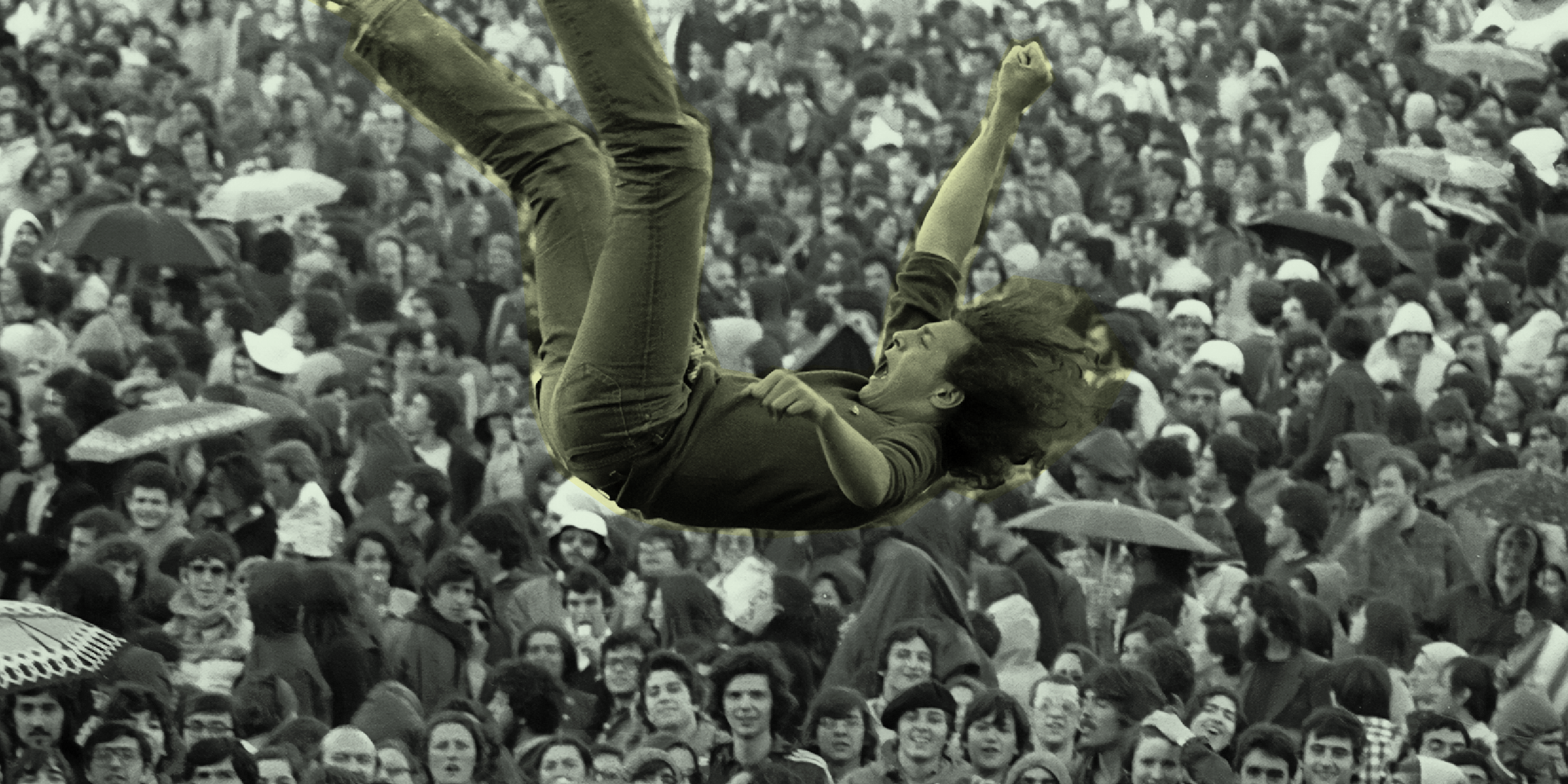
Cover image: Photograph by Guillermo Armengol. Festival of the Iberian Peoples, Universidad Autónoma, Madrid, May 10, 1976. The image is part of the exhibition “Winds of the People. On Iberian Revolutions and Transitions (1974–1977)”, organized by the Spanish Ministry of Culture in collaboration with the Portuguese Ministry of Culture and the Commissioner for the Celebration of 50 Years of Freedom in Spain.
Programme
The PDF version can be downloaded here.
Tuesday 18th November 2025
9 am – Registration/ Arrival of participants
9.30 am – Welcome words by Constanze Itzel (House of European History), Jordi Guixé i Coromines (EUROM), Almudena Cruz Yábar (Spain State Secretariat for Democratic Memory) and Carlos Moreno Blanco (Spain’s State Secretary for the European Union)
10 am – The Spanish dictatorship in comparative perspective: a transnational dialogue with leading historians of European authoritarianism, with: Angel Viñas, Laure Neumayer and Victor Fernández Soriano. Chaired by Sigfrido Ramirez from the Université Libre de Brussels (MMC-ULB)
11.30 am – Innovative strategies for communicating memories of dictatorships and public crimes.
Art as a medium of intervention and critical engagement, with artists Fernando Sánchez Castillo and Cristina Lucas. Chaired by Anna Tilroe (Dutch art critic and curator).
12.30 pm – Lunch break
1.45 pm – Curated tour to the temporary exhibition “Presence of the past” with standing guides: Introduction by Simina Badica(House of European History). Dora Ivanova (Buzludzha Project, Bulgaria), Marije Hristova (Spanish National Research Council – CSIC), Anne Thomas (Stolpersteine, Germany) and Chantal Kesteloot (Cegesoma/State Archives, Belgium)
3pm – Re-signifying European dissonant heritage. Lessons to be learned for the Spanish cases. A panel about European sites of contested memory as inspiration to re-significate dissonant heritage in Spain, with Ayoko Mensah (House of European History), Rita Rato (Museu do Aljube, Portugal), Christian Dürr (Mauthausen Memorial) and Magda Fytili (Contemporary Social History Archives of Greece, ASKI). Chaired by Paco Ferrándiz (Spanish National Research Council – CSIC).
4.30 pm – Coffee break
5 pm – “Exilio”, a multilingual performance reflecting on historical and contemporary exile in Europe with Nora Buschmann and Alex Brendemühl
5.45 pm – Closing words and end of the conference
Playlist
Speakers
Ángel Viñas
Emeritus Professor of Economics at Universidad Complutense de Madrid and distinguished historian and diplomat. Former Director-General at the European Commission and EU Ambassador to the UN. His research focuses on the Spanish Republic, Civil War, and Franco regime. New book: Franco’s Black Gold: Oil and Espionage in the Spanish Civil War (Crítica, 2025).
Laure Neumayer
Professor of Political Science at Université de Picardie Jules Verne, Amiens, France. Specializes in sociology of European integration and memory studies, focusing on Central Europe. Publications include The Criminalisation of Communism in the European Political Space after the Cold War (2019) and Condamner le passé ? (2019).
Victor Fernández Soriano
Professor of Contemporary History at ULB, Belgium. Researches human rights in European and international politics (20th century). Author of Le fusil et l’olivier (2015) and co-author of The 1969 ‘Greek Case’ at the Council of Europe.
Fernando Sánchez Castillo
Spanish artist (b. 1970, Madrid) working with sculpture, video, and installations on power, memory, and monuments. Exhibited at Tate Modern, MoMA PS1, and São Paulo Biennial.
Cristina Lucas
Multidisciplinary Spanish artist (b. 1973, Úbeda) working in performance, video, installation, painting, and drawing. Her works engage with feminism, colonial discourse, and power structures. Held in Centre Pompidou and MUSAC collections.
Ayoko Mensah
Franco-Togolese curator, cultural expert, and journalist with 25+ years in African and Afro-descendant art scenes. Curator at the House of European History, Brussels, preparing an exhibition on Europe’s colonial legacies (2026).
Rita Rato
Director of Museu do Aljube – Resistência e Liberdade, Lisbon. Former Portuguese Parliament member (2009–2019). Curated major exhibitions including 25 April ALWAYS! (2024) and Before it was Independence, it was a Liberation Struggle (2025).
Christian Dürr
Historian and curator at Mauthausen Memorial, Austria. Research on Nazi concentration camps, memory studies, and Argentine dictatorship. Head of Archives and permanent exhibitions at Mauthausen and Gusen memorials.
Magda Fytili
Ramón y Cajal Postdoctoral Researcher (UCM), Associate Professor (HOU), member of ASKI, Greece. Research: transitional justice, memory politics, forced migration, authoritarian legacies.
Curated Tour
Simina Bădică
Curator at the House of European History, Brussels. Led Fake for Real exhibition (2020–2021). PhD in History (CEU, Budapest). Researches curatorial practices, memory, and representation in museums.
Dora Ivanova
Architect and social entrepreneur, founder and CEO of Buzludzha Project Foundation, aimed at preserving and transforming this dissonant heritage site from Bulgaria’s communist era into a world-class cultural destination, a platform for education and dialogue.
Marije Hristova
PhD researcher in cultural, forensic, and environmental memory (Spain, Eastern Europe). Ramón y Cajal fellow at CSIC, investigates mass graves, uranium mining legacies, and transnational memory frameworks.
Anne Thomas
Cultural practitioner specializing in European memory initiatives. Oversees Stolpersteine placement outside Germany and translations. Freelance journalist and translator in Berlin.
Chantal Kesteloot
Doctor of Contemporary History, senior staff at CEGESOMA/State Archives, leads Public History department. Researches on Brussels history, WWI/WWII memory. Coordinates www.belgiumwwii.be.
Moderators
Sigfrido Ramírez
Scientific Collaborator, MMC, ULB. Teaches European integration history (University Paris 8). Associated researcher, Max Planck Institute, Frankfurt.
Anna Tilroe
Dutch art critic, writer, and curator. Organized Sonsbeek 2008 and 11Fountains. Former professor, Radboud University. Awards: Pierre Bayle Prize, Arnhem Culture Prize, Anna Maria van Schurman Prize.
Paco Ferrándiz
Tenured researcher, CSIC. Anthropology of the body, violence, and social memory. PI, Politics of Memory Exhumations in Contemporary Spain. Former Senior Advisor, State Secretariat for Democratic Memory.
Performance
Exilio is a multilingual performance reflecting on historical and contemporary exile in Europe, created by EUROM and Voodoo Productions. Featuring actor Àlex Brendemühl and guitarist Nora Buschmann, directed by Lalo Garcia and produced by Txell Sabartés. Launched in 2020, Exilio has been presented to over 4,000 spectators across Spain, France, and Germany.
Survey
This activity is co-financed by the European Commission and for its evaluation we kindly ask your collaboration in filling out this survey. It will take about 10 minutes, and you will need the information indicated below. Thank you very much!
- Reference of the Project: 101194553
- Type of activity: Mutual Learning
- Title: 50 years after Franco
Press Release
