
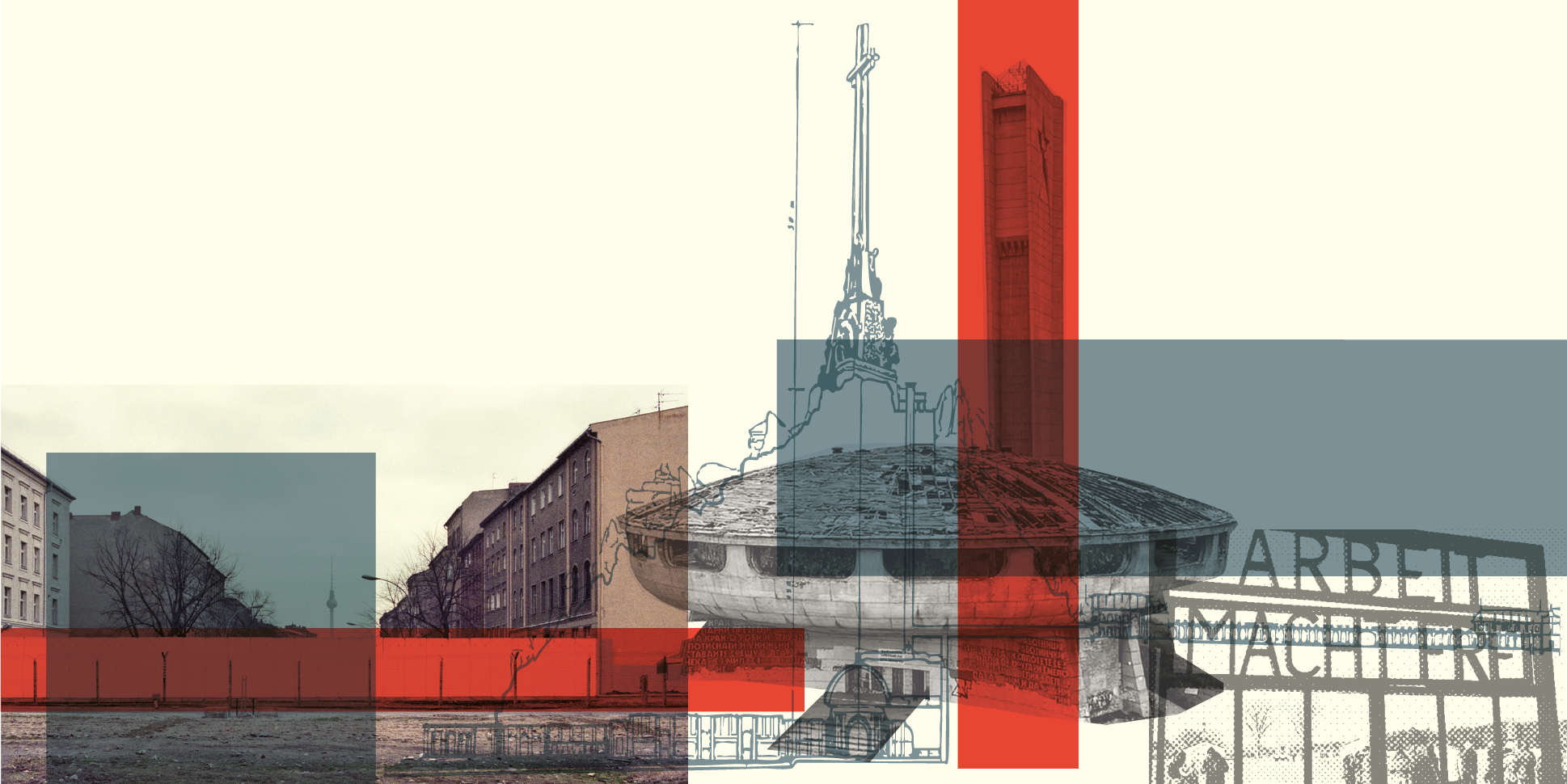
The 9th EUROM Network Meeting, “Architectures of Discomfort”, will gather architects, artists, urban planners and policymakers on 3–4 November at the Instituto Cervantes in Berlin, with an optional guided tour of Holocaust and memory sites on 5 November.
Berlin, October 25, 2026 – How should societies deal with monuments, buildings and urban spaces that embody dictatorship, war, colonialism or state violence? Should they be preserved, reinterpreted, transformed or removed, and who decides? These are the questions at the centre of Taking Stock of European Memory Policies 2026, the 9th Meeting of the EUROM Network, which takes place at the Instituto Cervantes in Berlin from 3 to 5 November 2026.
Under the title Architectures of Discomfort: Heritage and Sites of Memory, the meeting invites participants to reflect on public memory as a form of collective heritage, both as an intangible social and political process and through its material presence in the built environment. Seven panels and an opening keynote will address architecture, urbanism, heritage policies, museology, public art and civic participation.
The conference will examine the decision-making processes behind memorial projects, the tension between historical preservation and contemporary democratic values, and the economic and institutional challenges involved. It will also stress the need to place victims and affected communities at the centre of memory policies, and link these debates to current European initiatives, such as the evolution of the CERV programme.
A programme rooted in Berlin and open to all of Europe
The opening keynote, Making the Past Present at Sites of Contested Memory, will be delivered by German architect and museum designer HG Merz and moderated by Stefanie Endlich (Universität der Künste Berlin). Over two days, panels will explore:
- Architecture for memorial heritage and civic values in public space, with architects Philippe Prost and Annalisa de Curtis.
- Urbanism and memory landscapes, with Liliana Iuga (RWTH Aachen University), Kathrin Golda-Pongratz (UPC) and Axel Klausmeier, Director of the Berlin Wall Foundation.
- The new AgoraEU and CERV+ programmes, with Barbara Gessler, Head of the European Commission Representation in Germany, Markus Prutsch (European Parliament) and the CERV-REM-OG beneficiary organisations: the Association of European Jewish Museums, Documenta Zagreb, ENRS, EuroClio and the Mémorial de la Shoah.
- Dissonant heritage in the making, with case studies from Bulgaria, Italy and Germany, including Dora Ivanova of the Buzludzha Project Foundation.
- Re-signifying contested heritage, from state violence to colonial legacies, with counter-monument artist Horst Hoheisel, Nasra Elliott (National Museums Liverpool) and José Miguel Gastón, former Director of the Institute for the Memory of Navarre.
- The role of the arts in shaping memory, with playwright Maria Milisavljević and artist Monica Bonvicini.
- Memory from an artistic perspective, with artists Pilar Millán and Maria Amparo Gomar Vidal.
The meeting will close with an optional guided tour, Holocaust and Memory Sites in Berlin, curated by Stefanie Endlich, on Thursday 5 November.
Jordi Guixé, Director of EUROM:
Across Europe we have inherited places built to glorify dictatorships and to silence their victims. Leaving them untouched keeps serving the message of those who built them, but removing them without more leaves an empty space and nothing to explain to future generations. In Berlin, a city that has spent decades confronting its past through its urban landscape, we want to discuss a third way: turning these places into spaces of learning and collective reflection, with victims and affected communities at the centre.
Ignacio Martínez-Castignani, Director of the Instituto Cervantes in Berlin:
The Instituto Cervantes is the public institution of the Kingdom of Spain responsible for promoting Spanish culture and culture in the Spanish language, as well as teaching and certifying proficiency in Spanish worldwide. The recovery of Spanish and European memory is one of the strategic priorities of its annual programme. This work is carried out with complete political neutrality, in accordance with clear and consistent standards of historical rigour, and with respect and sensitivity towards all perspectives, including the emotional dimensions that the recovery of historical and living memory evokes in public and democratic debate.
The event is open to the public and will bring together academics, policymakers, architects, artists, and representatives of European institutions and civil society organisations. Admission is free, and advance registration via the online form is recommended.
The full programme is available at this link.
Download the Press Kit
Explore the panels’ descriptions, and the biographies of speakers and moderators
Event at a glance
| Event | Taking Stock of European Memory Policies 2026 – 9th EUROM Network Meeting |
| Title | Architectures of Discomfort: Heritage and Sites of Memory |
| Dates | Tuesday 3 – Wednesday 4 November 2026 (optional guided tour: Thursday 5 November) |
| City | Berlin |
| Venue | Berlin Cervantes Institute Rosenstraße 18, 10178 |
| Format | In-person, open to the public |
| Languages | Englsih/Spanish |
| Registration | Free, online registration is recomended |
| Organisers | European Observatory on Memories (EUROM) and Instituto Cervantes Berlin |
| In collaboration with | Jean Monnet House and the Institute of Memory of Navarre |
| Funding | Co-funded by the CERV programme of the European Union (Project reference 101236354) |
| Hashtag / social | #TSEuropeanMemories2026 @euromemories |
Press contact: Fernanda Zanuzzi, Press and Communications, EUROM · [email protected]