
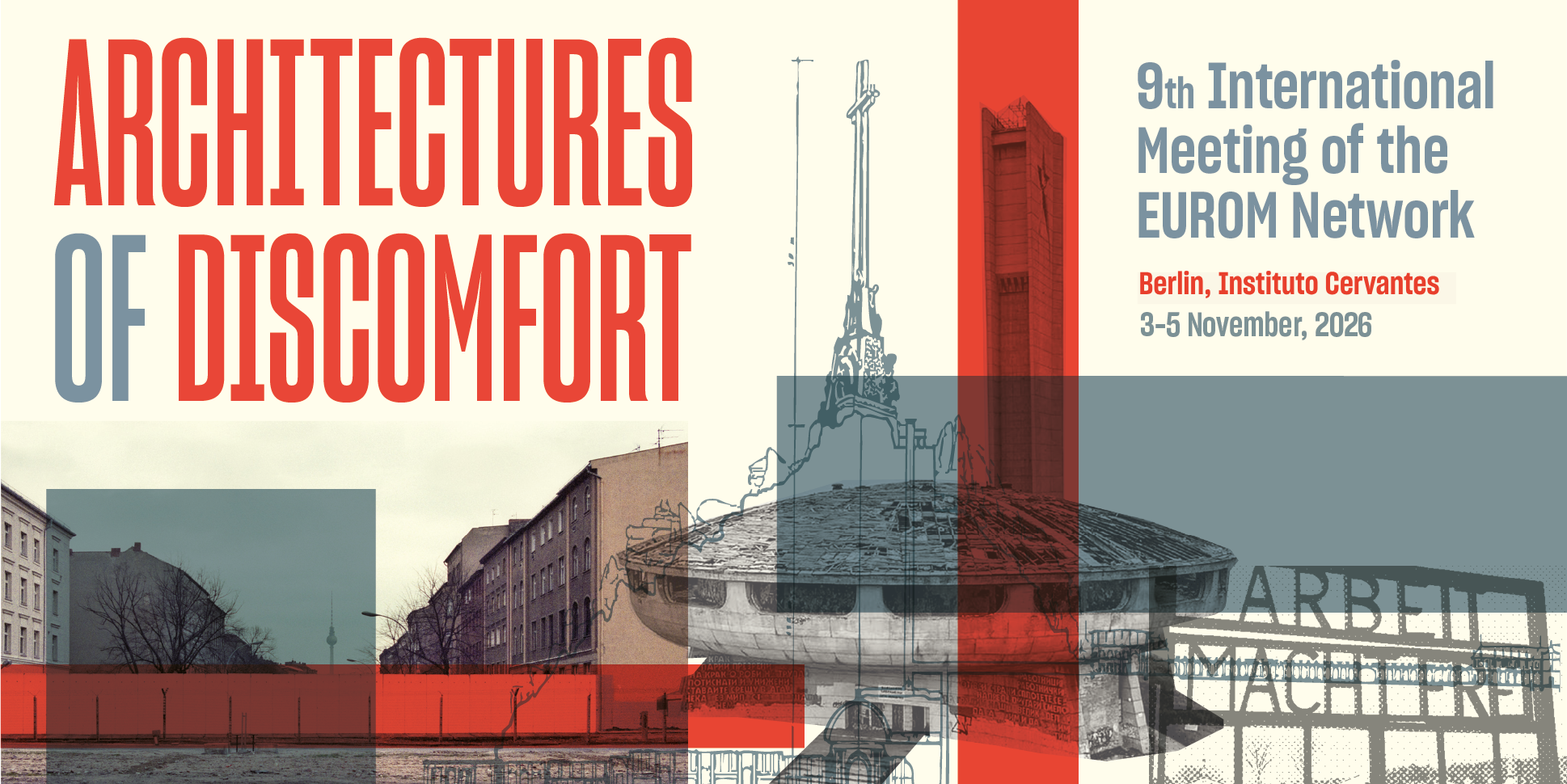
The 9th Meeting of the EUROM Network–Taking Stock of European Memory Policies will take place in Berlin on November 3 to 5 under the title Architectures of Discomfort, inviting participants to reflect on public memory as a form of collective heritage. This year’s meeting explores the dual nature of memory: its intangible dimension as a shared social and political process, and its material presence in monuments, buildings, landscapes and urban spaces that embody difficult and often contested pasts in an increasingly digital and fluid present.
Organised by the European Observatory on Memories (EUROM) and the Instituto Cervantes Berlin, the three-day event will examine how processes of memorialisation shape democratic public spaces while engaging with dissonant and uncomfortable heritage. Through discussions on architecture, urbanism, heritage policies, museology, public art and civic participation, the event will address the political, social and ethical challenges involved in preserving and transforming places marked by violence, dictatorship, colonialism and other traumatic histories.
Heritage and Sites of Memory
Berlin—and Germany more broadly—provides a particularly meaningful setting for these discussions, given its internationally recognised experience in confronting difficult pasts through interventions in the urban landscape. The conference will explore the political decision-making processes behind memorial projects, the tensions between historical preservation and contemporary democratic values, the economic and institutional challenges they face, and the need to place victims and affected communities at the centre of public memory policies. The programme will also connect these debates with current European initiatives, including the evolution of the Citizens, Equality, Rights and Values (CERV) programme and new EU policies supporting democratic remembrance and heritage.
The meeting is open to the public and will bring together academics, policymakers, architects, artists, representatives of European institutions, and civil society organisations from across Europe. Representatives of the European Commission, the European Parliament, and the wider EUROM network are expected to participate, fostering dialogue between research, public policy and cultural practice.
Beyond the conference sessions, participants will have opportunities for networking and exchange, concluding with an optional guided visit to Berlin’s Holocaust and memory sites curated by Stefanie Endlich, offering a first-hand perspective on one of Europe’s most significant urban landscapes of remembrance.
Programme
Tuesday, 3 November
3:30 pm – Registration of participants
4:00 pm – 4:15 pm – Welcome remarks
- Barbara Gessler, Head of Representation of the European Commission in Germany
- Ignacio Martínez-Castignani, Head of the Instituto Cervantes Berlin
- Jordi Guixé, Director of the European Observatory on Memories (EUROM)
4:15 – 5:15 pm – Opening keynote
Making the Past Present at Sites of Contested Memory
- HG Merz, Architect
Followed by discussion and Q&A, moderated by Stefanie Endlich
5:15 – 5:30 pm – Coffee break
5:30 – 6:45 pm – Panel 1
Architecture for Memorial Heritage and Civic Values in Public Space
- Philippe Prost, Architect and Professor (ENSA Paris-Belleville)
- Annalisa de Curtis, Architect and Professor
Moderated by Jordi Guixé, EUROM
6:45 – 8:00 pm – Panel 2
Urbanism and Memory landscapes
- Liliana Iuga, Institute for Urban Design and European Urbanism (RWTH Aachen University)
- Kathrin Golda-Pongratz, Polytechnic University of Catalonia (UPC)
- Axel Klausmeier, Berlin Wall Foundation
Moderated by Debora Righetti, Maison Jean Monnet
8:00 pm – Welcome cocktail and networking
Wednesday, 4 November
9:00 am – Registration of participants
9:30 am – 10:45 am – Panel 3
Rethinking Memorial Values: The New AgoraEU and CERV+ programmes
- Barbara Gessler, Head of the Representation of the European Commission in Germany
- Markus Prutsch, European Parliament
- CERV-REM-OG Beneficiary Organizations
Followed by Q&A moderated by Oriol López, EUROM
10:45 am – 11:00 am – Coffee break
11:00 am – 12:30 pm – Panel 4
Dissonant Heritage in the Making: Contributions from Across Europe
- Harald Bodenschatz, Social Scientist and Urban Planner and Victoria Grau, Urban Planner and Doctoral Researcher
- Dora Ivanova, Architect (Buzludzha Project Foundation)
- Alessia Zampini, Architect and Professor (University of Bologna)
- Birgit Kann, Federal Institute for Research on Building, Urban Affairs and Spatial Development (BBSR)
Presented and moderated by Jan Schultheiß, German Federal Ministry for Housing, Urban Development and Building, Vibrant Communities, National Urban Development Projects (BMWSB)
12:30 pm – 2:00 pm – Lunch and networking
2:00 pm – 3:30 pm – Panel 5
Re-signifying Contested Heritage: from State
Violence to Colonial Legacies
- Horst Hoheisel, Artist
- Nasra Elliott, Engagement Producer at National Museums Liverpool
- José Miguel Gastón Aguas, Instituto Navarro de la Memoria
Moderated by Daniel Rico, Autonomous University of Barcelona (UAB)
3:30 pm – 4:00 pm – Coffee break and networking
4:00 pm – 5:00 pm – Panel 6
The Role of the Arts in Shaping Memory
- Maria Milisavljević, translator and playwright
Theatre as a Tool for Political History - Monica Bonvicini, Universität der Künste Berlin
Moderated by Piedad Solans, curator and PhD in Art History
5:00 pm – 6:00 pm – Panel 7
Memory from an Artistic Perspective
- Pilar Millán, Artist
- Maria Amparo Gomar Vidal, Artist (“Spanische Allee”)
Moderated by Nuria Ricart Ulldemolins, University of Barcelona
6:15 pm – Closing remarks
Thursday 5 November (optional)
10:30 am – 12:30 pm – Guided tour
Holocaust and Memory Sites in Berlin
- Curated by Stefanie Endlich, Honorary Professor of Art in Public Space at the Berlin University of the Arts (UdK)
Organizing Committee
Organized by the European Observatory on Memories of the University of Barcelona Solidarity Foundation and Instituto Cervantes Berlin, with the collaboration of the Jean Monnet House and the Institute of Memory of Navarre. Co-funded by the programme Citizens, Equality, Rights and Values of the European Commission.
- Jordi Guixé, European Observatory on Memories
- Ignacio Martínez-Castignani, Instituto Cervantes
- Oriol López Badell, European Observatory on Memories
- Jan Schultheiß, German Federal Ministry for Housing, Urban Development and Building, Vibrant Communities, National Urban Development Projects
- Stefanie Endlich, Honorary Professor, University of Künste
- Piedad Solans, curator and independent researcher
- Nuria Ricart, University of Barcelona (UB)
- Daniel Rico, Autonomous University of Barcelona (UAB)
- David González,European Observatory on Memories
- Ricard Conesa, European Observatory on Memories
- Fernanda Zanuzzi, European Observatory on Memories
- Andrea Carrera, European Observatory on Memories
- Marti Grau Segú, Jean Monnet House
- Debora Righetti, Jean Monnet House
Survey
This activity is co-financed by the European Commission and for its evaluation we kindly ask your collaboration in filling out this survey. You will need the information indicated below. Thank you very much!
- Reference of the Project: 101236354
- Type of activity: Mutual Leraning
- Title: Taking Stock of European Memory Policies 2026
- Date: November 3, 2026
- 3 Days
- Physical event
- Berlin