
One week before the 40th anniversary of the Chernobyl disaster, around twenty scholars, researchers and memory practitioners gathered in Florence and online for the fifth edition of the Subaltern Memories conference, organised by the European Observatory on Memories (EUROM) and the European University Institute (EUI). Under the title Remembering Environmental and Natural Disasters in Europe, the one-day conference explored how ecological catastrophes, wars and technological failures continue to shape collective memory, public debate and democratic responsibility across Europe.
Held at Villa Salviati, home of the Historical Archives of the European Union, and streamed online to an international audience, the event brought together experts from different disciplines to examine environmental disasters not simply as isolated tragedies, but as political, social and cultural processes whose consequences remain visible — and often invisible — decades later.
Opening the conference, historian Monika Baar underlined the importance of addressing forms of memory that often remain outside official narratives. Reflecting on the origins of the collaboration with EUROM, she recalled her first encounter with the Subaltern Memories programme several years ago, when she was invited to speak about the memories of disabled communities. “Most people, even those very knowledgeable about memory studies, would not even know that such a topic is valid,” she said, praising the initiative for being “ahead of the curve” in broadening the scope of memory studies.

Baar stressed that the 40th anniversary of the Chernobyl catastrophe provided an opportunity not only to revisit the nuclear disaster itself, but also to open wider reflections on environmental destruction, memory and European integration. She highlighted the relevance of Italy’s own environmental anniversaries — from the Vajont Dam disaster to the Seveso chemical accident — and the importance of archival work in understanding how Europe has historically addressed ecological crises.
Representing the Government of Catalonia in Italy, Luca Bellizzi framed memory as a democratic responsibility rather than a commemorative exercise. Speaking at the opening session, he described the remembrance of environmental disasters and marginalised communities as “a political act,” warning that memory is constantly vulnerable to manipulation, erasure and silence.
Bellizzi also highlighted 2026 as a symbolic year for both the EUI and Catalonia: the EUI celebrates fifty years since welcoming its first researchers, while Catalonia marks forty years since Spain’s accession to the European Communities. He praised EUROM’s role in turning Barcelona into “an international centre of excellence” in democratic memory policies through a network that now spans dozens of institutions across Europe.
For Jordi Guixé, the conference reflected EUROM’s broader mission of connecting academic research, public policy and civic debate. Guixé emphasised that so-called “natural disasters” cannot be separated from human and political responsibility. “It’s not only natural,” he remarked. “It is because of human and humanity also disasters.” He called for a “post-memory position” capable of confronting contemporary geopolitical conflicts, ecological destruction and the long-term legacies of violence through comparative and transnational perspectives.
War and environmental consequences
The conference’s first panel focused on the relationship between war and environmental destruction. Historian Corinna Unger opened the discussion with a historiographical overview of environmental history, analysing the growing influence of concepts such as the Anthropocene and climate change in contemporary scholarship. Her intervention examined how environmental history has moved from the margins to the mainstream of historical research, while also raising questions about whose environments and whose experiences become visible in these narratives.
Environmental historian Santiago Gorostiza then explored the role of water during the Spanish Civil War. Through the cases of the defence of Madrid and the Battle of the Ebro, he showed how hydraulic infrastructures became strategic military targets and instruments of warfare. Reservoirs, dams and river flows were transformed into weapons, while engineers and workers mobilised urban water systems to sustain civilian life under siege. His lecture demonstrated how environmental history can reveal overlooked dimensions of armed conflict and its enduring ecological consequences.
The environmental consequences of war also resonated in the presentation by Ukrainian researcher Polina Baitsym, who addressed the destruction of the Nova Kakhovka dam in Ukraine in 2023. Through contemporary Ukrainian artistic responses, she analysed how wartime violence reshapes landscapes and memory. Her presentation described artistic practices that navigate between absence and presence, documenting submerged territories and interrupted lives while transforming art into a form of commemoration.

Environmental impacts of technological disasters in Italy: memory and recognition
The second panel turned to Italy’s experience of technological disasters. Anthropologist Chiara Calzana revisited the 1963 Vajont Dam catastrophe, where a massive landslide into a hydroelectric reservoir destroyed entire communities. Drawing on ethnographic research with survivors and descendants, Calzana argued that the tragedy was not a “natural” disaster but the consequence of political and economic decisions driven by profit and disregard for local populations and ecosystems.
In her own presentation, Baar analysed the memory of the 1976 Seveso disaster near Milan, when a toxic cloud of dioxin spread over densely populated areas following an explosion at a chemical plant. Her intervention examined the social conflicts generated by the disaster, including debates over abortion rights, industrial responsibility and environmental contamination. Baar traced how two competing narratives emerged over time: one centred on community and religious identity, and another interpreting Seveso as a critique of capitalist exploitation. She also reflected on the cyclical nature of remembrance, particularly the role anniversaries play in bringing environmental disasters back into public consciousness.
Keynote: A Beacon of Hope, a Catastrophe, a Landscape Scar. Chernobyl’s (In-)visible Impact
The conference concluded with a keynote lecture by historian Achim Klüppelberg on the changing meanings of Chernobyl across four decades. Klüppelberg described the nuclear plant as both a symbol of Soviet modernity and a “landscape scar” marked by invisible suffering and unresolved trauma. His presentation explored how institutional responses, geopolitical interests and the lobbying power of the nuclear industry gradually displaced attention away from individual victims and long-term environmental damage.
Referring to the ongoing war in Ukraine and recent drone attacks near the Chernobyl site, Klüppelberg warned that the catastrophe continues to evolve rather than belong solely to the past. “Healing has to take place,” he argued, while noting that technocratic approaches still tend to overshadow human experiences and collective recovery.
Visiting the Historical Archives of the European Union
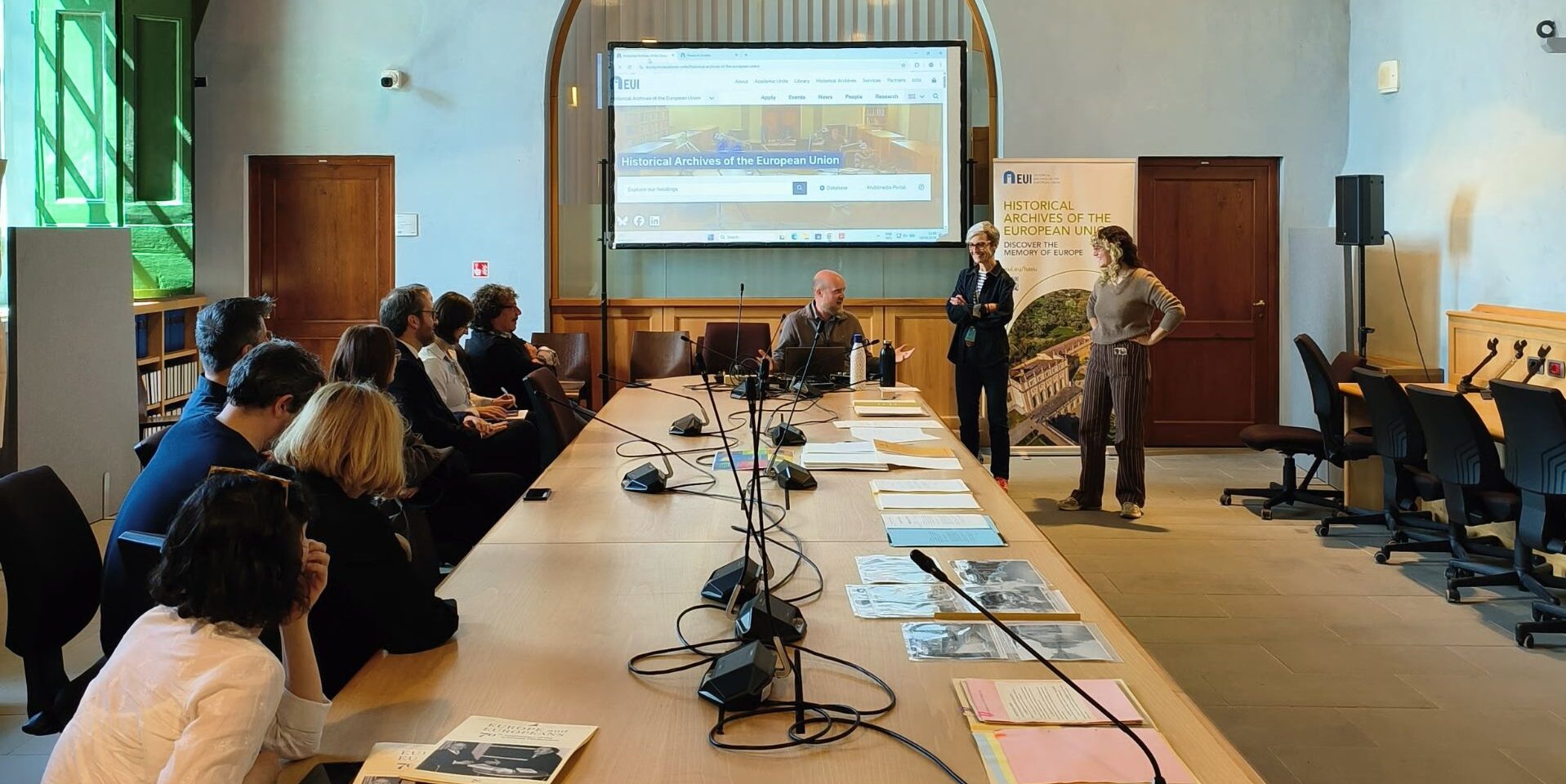
Beyond the academic discussions, participants also visited the Historical Archives of the European Union, where original documents related to European environmental policy offered a material perspective on the relationship between ecological crises, governance and memory. Hosted by Jacopo Cellini and Valérie Mathevon, the visit offered an opportunity to engage directly with archival materials. By preserving and making accessible both the archives of European Union institutions and private collections related to European integration, the HAEU plays a key role in supporting research, public outreach and transparency, while helping to connect historical memory with present-day democratic debates.

By connecting the histories of Chernobyl, Seveso, Vajont, the Spanish Civil War and contemporary Ukraine, the fifth edition of Subaltern Memories highlighted the importance of bringing marginalised environmental histories into public debate. The conference reinforced EUROM’s commitment to examining how democratic societies remember violence, displacement and ecological destruction — and how those memories can contribute to more critical and inclusive public policies in Europe today.