
Season 2
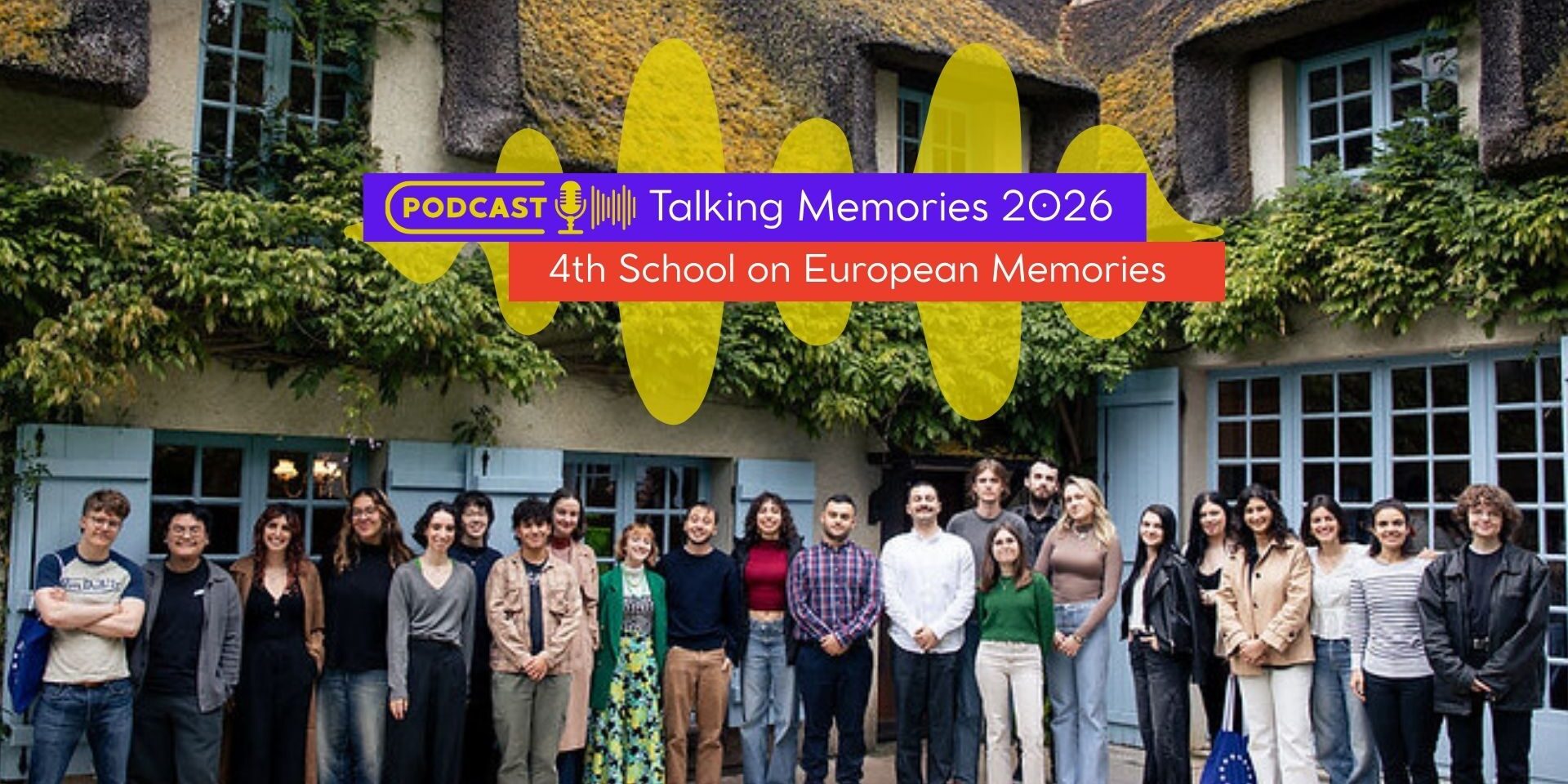
Talking Memories returns with a new four-part podcast series recorded during the fourth edition of the School on European Memories, held at the Jean Monnet House in May 2026. Bringing together young voices from across Europe, the series explores how historical narratives and collective memories shape our understanding of the past and influence contemporary European societies.
Under the theme Who Owns the Past?, the second season episodes address some of the key questions surrounding European memory today, from the role of historical myths and the construction of European identity to the possibility of a shared European memory and the contemporary remembrance of the Holocaust.
Each episode features a conversation between young participants of the School and an invited expert, offering different perspectives on the challenges of remembering the past and its significance for the present.
The four episodes are available on YouTube and Spotify.
Episode Guide
Episode 1 – How Myths Drive Our Understanding of History in the Present
How do historical myths shape the way we understand the world today? From national narratives to collective identities, myths continue to influence politics, public debate, and our perceptions of the past.
Hosted by David Duong, Lluïsa Nieddu, Irem Karamik, Ognjen Radišić, and Elli Kivivuori, this episode features a conversation with Matteo Bassoli, Associate Professor at the Department of Political Science, Law and International Studies at the University of Padua. Together, they explore how historical myths are created, why they persist, and how they shape contemporary societies.
Episode 2 – European Identity on the Test
What does it mean to be European in an increasingly diverse and changing world? Can a shared identity emerge from different histories, cultures, and collective memories?
Hosted by Viktoriia Zhuk, Francesco Piredda, Giorgi Tkabladze, Sára Bányai, and Laura Piñeiro Gómez, this episode features Ana Milošević, Research Fellow at the Institute for European Studies at KU Leuven. The conversation examines the challenges of building a common European identity and the role of memory and politics in shaping the idea of Europe.
Episode 3 – Towards a Common and Unified European Memory?
Is it possible to establish a shared European memory while acknowledging the continent’s diverse and often conflicting pasts? Whose memories are included in European narratives, and whose remain overlooked?
Hosted by Hubert Otevrel, Eliza Sancioui, Artsiom Kamovic, Sara Arezes, and Mireia Iturralde, the episode features Xosé M. Núñez Seixas, Professor of Modern History at the University of Santiago de Compostela. The discussion explores the complexities of remembering Europe’s past across borders and the possibilities and limitations of a common European memory.
Episode 4 – Memories of the Holocaust in the Present Day
How is the Holocaust remembered today, and why does its memory remain essential to contemporary society? As survivors pass away and historical distortion continues to pose challenges, preserving the memory of the Holocaust takes on renewed significance.
Hosted by Roberta Annunziata, Varvara Melnikova, Karolina Kruzlak, Christian Matrone, Miguel Penades, and Bianca Alves de Andrade, this episode features Valentina Pisanty, Full Professor of Semiotics in the Department of Literature, Philosophy and Communication at the University of Bergamo. The conversation addresses Holocaust remembrance, the challenges of denial and distortion, and the importance of historical knowledge in contemporary society.
Credits and Acknowledgements
The episodes were recorded at the Jean Monnet House during the fourth edition of the School on European Memories, held in May 2026.
Funded by the European Union. Views and opinions expressed are however those of the author(s) only and do not necessarily reflect those of the European Union or the European Education and Culture Executive Agency (EACEA). Neither the European Union nor the granting authority can be held responsible for them.