
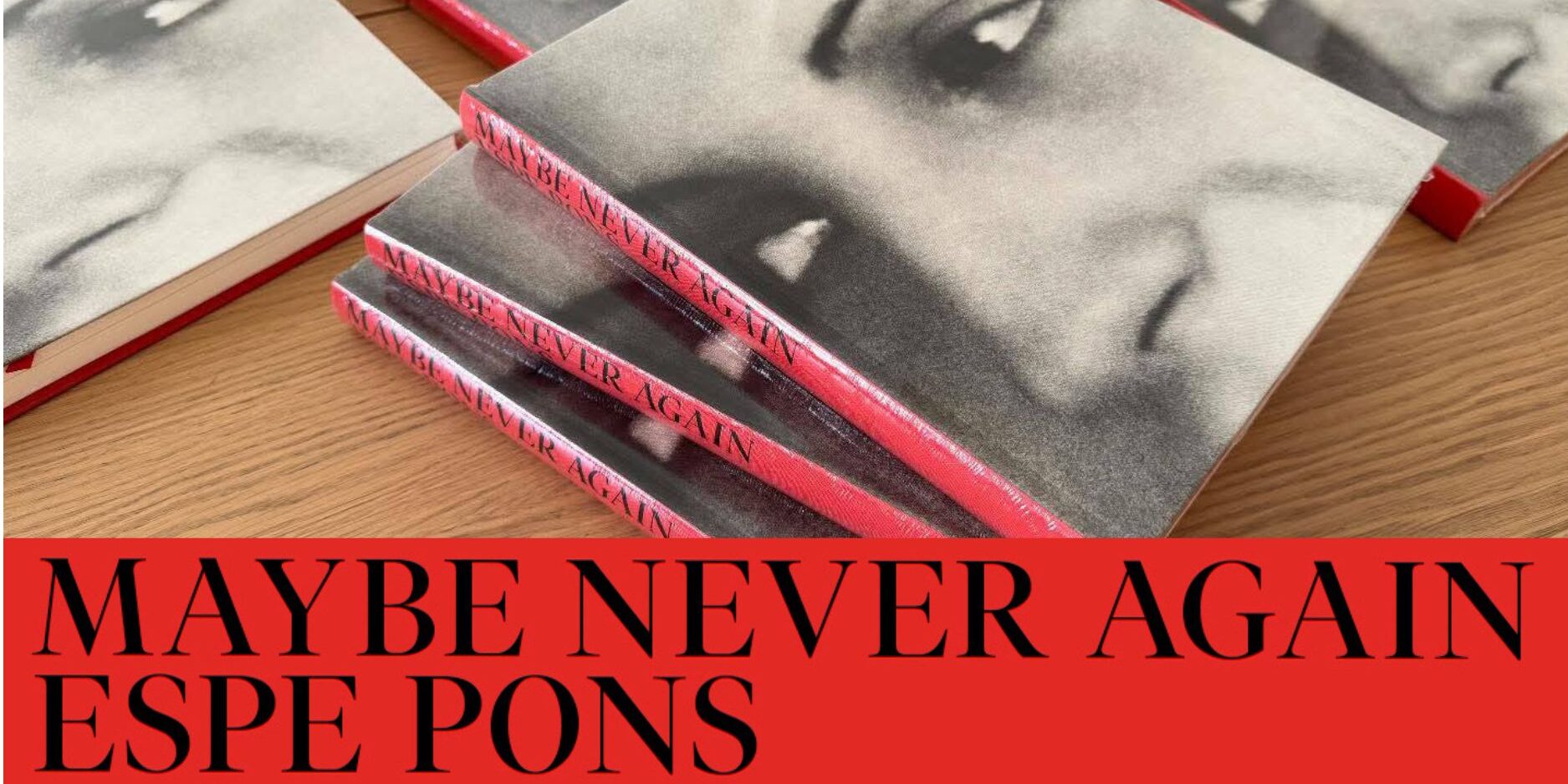
With Maybe Never Again (2025), artist Espe Pons consolidates a body of work that places photography at the service of memory, ethical responsibility, and historical vigilance. The self-published book brings together a selection of her most recent projects, focused on the Spanish Civil War, the repression that followed, and the broader landscape of European fascism, including the barbarity of Nazi Germany. Across its pages, memory is not treated as a closed chapter but as a fragile terrain that demands sustained attention.
Pons’s practice has long explored the relationship between landscape and absence, and here that approach becomes an act of insistence: a refusal to look away from injustice or to allow historical violence to fade into abstraction. The photographs evoke the silenced lives of victims of Francoism, as well as the experiences of those who resisted fascism across borders. Central to the book is a focus on the role of foreign women in the anti-fascist struggle, whose political commitment and personal sacrifice are woven into the visual narrative with restraint and care.
The project is also deeply rooted in personal history. Pons turns her gaze toward her own family past, recalling the fate of her great-uncle, who fought on the Republican side during the Spanish Civil War and died in the subsequent repression. This intimate connection informs the empathy with which she approaches other sites and stories marked by similar losses, allowing the work to resonate beyond individual biography and into a shared European memory.
The emotional weight of Maybe Never Again was powerfully evident during its first public presentation at the Centro de la Imagen in Mexico City. Accompanied by Rosa Casanova—author of the text on Tina Modotti included in the book—as well as Solange Heller and Tobyanne Berenberg, daughters of women whose lives are part of this history, the presentation became a collective act of remembrance. The gathering functioned not only as a book launch but as a tribute to a generation of women whose lives intersected with exile, resistance, and loss.
As a photobook, Maybe Never Again succeeds in balancing documentary rigor with emotional resonance. It does not seek spectacle; instead, it invites slow looking and reflection, trusting the viewer to engage with what is shown and, equally, with what remains unseen. The result is a work that speaks quietly but insistently, reminding us that the dangers faced by past generations are not confined to history.
The publication was produced with the collaboration of the European Observatory on Memories (EUROM) of the University of Barcelona’s Solidarity Foundation, reinforcing the project’s commitment to transnational memory work and public engagement with Europe’s difficult pasts. In a moment marked by renewed threats to democratic values, Maybe Never Again stands as both a warning and a gesture of care—an invitation to remember, to feel, and to remain alert.