
The 3rd International Seminar “Places of Memory and Tourism: Uses and Disputes in the Management of Recent Heritage” will bring together researchers, professionals and specialists from different countries on 14 and 15 October to discuss how to preserve, interpret and open to the public sites associated with contested and difficult pasts.
Zaragoza/Belchite, 8 October 2026. What happens when places that bear the traces of a conflictive past also become sites of heritage and tourism? How should these places be preserved and interpreted? What role can they play in education and the transmission of memory? And how can new perspectives and audiences be incorporated without losing sight of the complexity of the events they represent?
These are some of the questions that will be addressed at the 3rd International Seminar “Places of Memory and Tourism: Uses and Disputes in the Management of Recent Heritage”, taking place on 14 and 15 October in Zaragoza and Belchite. Organised by the European Observatory on Memories (EUROM) of the Fundació Solidaritat UB, the Gernika Peace Museum and the Provincial Council of Zaragoza, the seminar will bring together researchers, memory practitioners, heritage professionals and specialists from a range of European and international contexts.
Over two days, the seminar will combine academic debate, professional experiences and practical approaches to explore the challenges involved in transforming sites associated with contested pasts into spaces of heritage, memory and tourism. Topics will include the preservation and reinterpretation of historical remains, heritage-making and musealisation processes, visitor experiences, the educational potential of these sites, and territorial initiatives aimed at making such places visible and fostering public engagement with them.
From Italy and Cyprus to Zaragoza: an international perspective
The first day, taking place on Wednesday 14 October at the former Assembly Hall of the Provincial Council of Zaragoza, will open with a keynote lecture by historian Stéphane Michonneau (Université Paris-Est Créteil) on Belchite as a Site of Memories.
The programme also has a strong international dimension. Researchers from Italy, Cyprus and Chile will present different approaches to managing sites associated with contested memories, ranging from the fascist remains of Predappio and memory sites in divided contexts in Cyprus to current challenges surrounding memory tourism in Chile.
The seminar will also explore experiences from Spain, including the former Miranda de Ebro concentration camp, educational trips to Mauthausen, the civil cemetery of La Barranca, the former prison in Sort, and initiatives related to the heritage of Republican exile and the recovery of memory sites and routes.
The day will conclude with a panel on territorial initiatives for memorial heritage, moderated by Iratxe Momoitio, director of the Gernika Peace Museum. The panel will feature Diego Gaspar Celaya, from the University of Zaragoza, presenting the European RECURUT project on trans-Pyrenean memory and history, and Jesús Alonso Carballés, from Université Bordeaux Montaigne, presenting the TRACES project, which focuses on identifying and enhancing the heritage of exile in France’s Nouvelle-Aquitaine region.
Belchite: a site of memory as a starting point
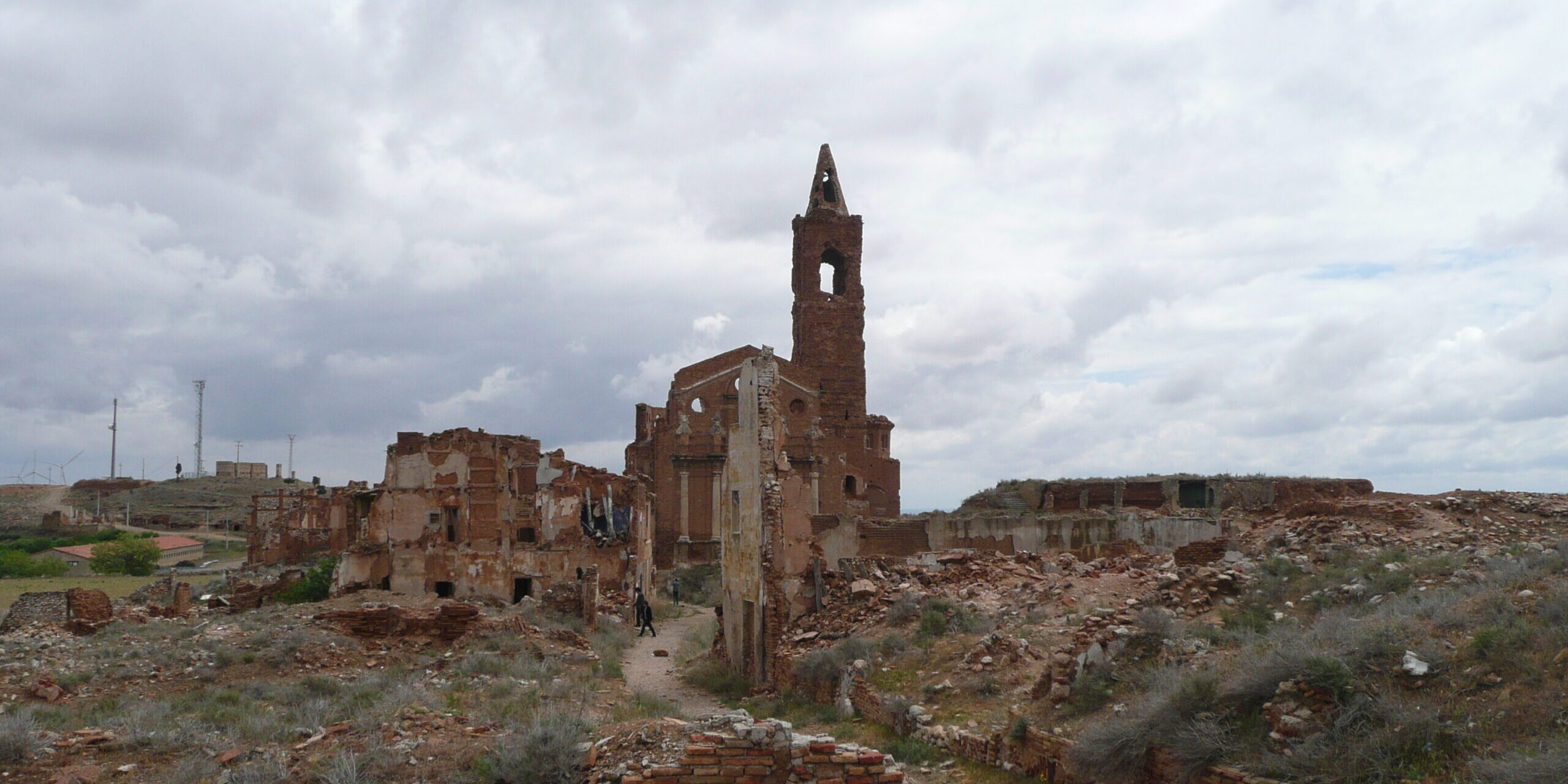
The second day will take the discussion into the territory itself. On Thursday 15 October, participants will travel from Zaragoza to Belchite for a visit to the Old Town, one of the most significant sites for exploring the relationship between conflict, memory, heritage and tourism.
The visit will provide an opportunity to examine first-hand the possibilities and challenges involved in managing a site marked by the destruction of the Spanish Civil War and subsequently transformed into a place of memory and public visitation.
At 4:00 pm, the seminar will conclude with the panel “The Belchites: Past, Present and Possible Futures”, an open discussion between speakers, invited specialists and the public on the issues raised during the seminar and their implications for the case of Belchite. The session will be moderated by Jordi Guixé, director of the European Observatory on Memories.
“Working with sites of memory means engaging with places where the past remains inscribed in the territory. Belchite offers a particularly clear opportunity to raise questions about preservation, interpretation, uses, tourism and the transmission of memory,” says Guixé.
The seminar therefore seeks to bring the case of Belchite into dialogue with experiences from other territories, moving beyond single narratives and encouraging a plural reflection on how contemporary societies engage with the material remains of their recent past.
Participation in the seminar is free of charge, upon registration. The full programme is available on the European Observatory on Memories website.
Related activity
Uses and Disputes in Managing the Heritage of the Recent Past