
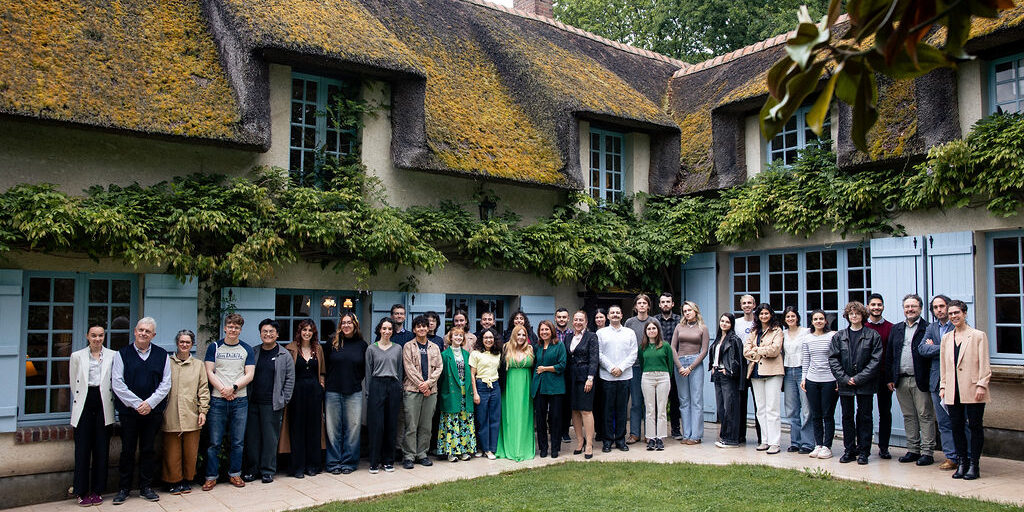
The fourth edition of the School on European Memories brought together 23 young participants and a multidisciplinary group of scholars and public voices to tackle one of the most pressing challenges facing European democracies: the growing influence of pseudo-historical revisionism and the instrumentalisation of the past for political purposes. Hosted at the Jean Monnet House in Bazoches-sur-Guyonne, the three-day programme was guided by a central question — “Who owns the past?” — and examined how history is written, transmitted, appropriated and, at times, distorted in contemporary public discourse.
Across lectures, workshops and collective discussions, the School explored the ways in which far-right and illiberal movements attempt to weaponise the recent past. The programme also focused on strategies of resistance grounded in academic research, critical pedagogy and responsible public communication, promoting active citizenship as a concrete response to memory manipulation. As participants repeatedly underlined throughout the School, democratic memory is not only about preserving the past — it is also about safeguarding democratic culture in the present.

A programme combining research, debate and hands-on communication
The academic sessions offered complementary angles on Europe’s contested memories. Matteo Bassoli (University of Padua) set the scene by addressing memory policies across Europe and the political dynamics that shape them. Xosé M. Núñez Seixas (University of Santiago de Compostela) examined the uses and abuses of historical revisionism from a European perspective, focusing on Fascism, Nazism and Francoism. Questions of Holocaust remembrance and the limits of “Never Again” were discussed with Valentina Pisanty (University of Bergamo), while Ana Milošević (Institute for European Studies, KU Leuven) unpacked how the past is rewritten, weaponised — and resisted — in contemporary political struggles.
The programme also connected memory debates with the history of European integration. Antonio Argenziano (European Movement International / Union of European Federalists) reflected on the thin line between history and stories, while Piero Graglia (University of Milan) explored memory and history through the figures of Altiero Spinelli and Ursula Hirschmann. The School concluded with recorded closing remarks by Nicolae Ștefănuță, Vice-President of the European Parliament, emphasising the democratic stakes of confronting manipulation and defending plural, evidence-based public debate.
From the classroom to the public sphere: producing the Talking Memories podcast
A distinctive feature of the School is its commitment to turning debate into accessible public content. Through a guided process and hands-on workshops, participants collaborated in small teams to produce four new episodes of Talking Memories — the School’s podcast. With the support of communications professionals from JEF, EUROM and the Jean Monnet House, sessions on scriptwriting and production helped participants translate complex issues into clear, rigorous and engaging audio narratives designed for wider audiences.

Learning through places: visits and shared experiences
Beyond the seminar room, the School included visits that connected memory work to tangible sites and stories. Participants visited Maison Louis Carré and took part in a historical walking visit in Paris from Hôtel de Ville to the Panthéon, followed by a guided visit of the Panthéon. These shared experiences helped bridge historical discussion with lived spaces of remembrance and commemoration.

Organisers: The Fourth School on European Memories has been organised by the Jean Monnet House (European Parliament), the European Observatory on Memories (EUROM) of the University of Barcelona Solidarity Foundation, the Young European Federalists (JEF Europe), the Istituto di Studi Federalisti Altiero Spinelli, and the commemoration “Spain in Freedom. 50 years”. It was co-funded by the CERV programme of the European Commission.
Full album available on Flickr