
Democracy at Stake? Memory in Times of Uncertainty
October 9–10, 2025 | University of Barcelona
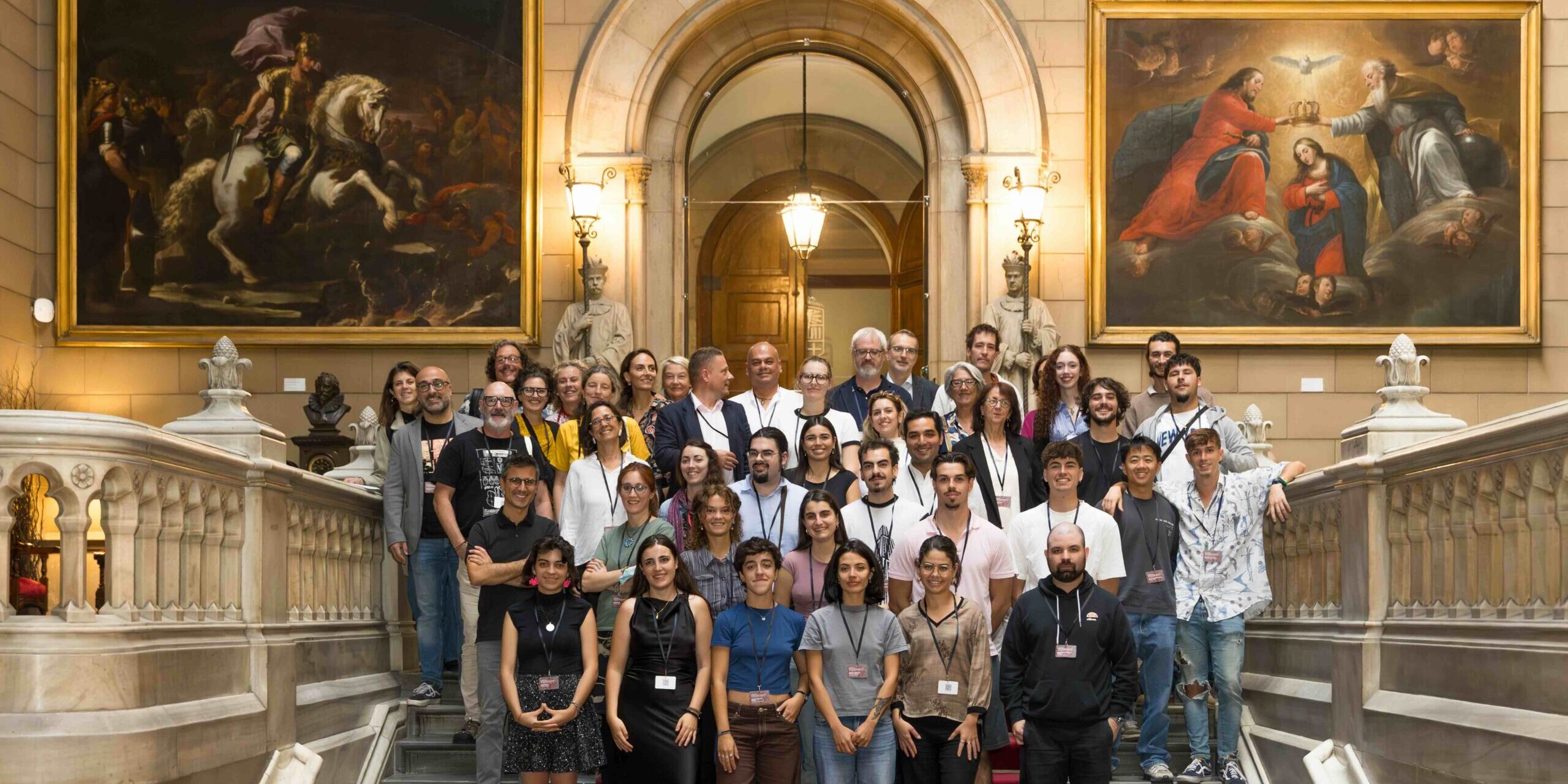
The 8th annual Taking Stock of European Memory Policies meeting, organized by the European Observatory on Memory (EUROM), brought together over 100 participants during two days, including 17 master’s students from the Interuniversity Master on Contemporary History coordinated by the University of Granada. Jointly hosted with the Commissioner for the commemoration “Spain in Freedom. 50 Years”—an initiative of the Ministry of Territorial Policy and Democratic Memory—and co-funded by Barcelona City Council and the CERV programme, the conference explored how collective memory shapes democracy in Europe.
For two days, scholars, policymakers, civil society representatives, and Members of the European Parliament engaged in discussions on memory politics, contested heritage, education, and transnational cooperation. The event emphasized the vital role of memory in defending democratic values and civil rights in times of uncertainty.
Welcome Session: A Call for Active Engagement and Democratic Resilience
The conference began with a welcome address stressing the importance of memory in promoting tolerance, democracy, and human rights. Organizers highlighted the transnational focus of the event, noting that effective memory policies require collaboration between research institutions, civil society, and public administrations. Representatives from all organizing entities emphasized the need to strengthen democracy through participation and critical reflection.
Jordi Guixé (EUROM) called for active civic engagement “in times of uncertainty,” urging the audience to revisit past crises to reclaim foundational values such as the welfare society, and reflected on emerging challenges including artificial intelligence and the idea of a federation of countries.
Zuzana Dorazilová, representing the Citizens, Equality, Rights and Values (CERV) programme of the European Commission, recalled that the European project was built “on the memory of the Holocaust” and the commitment to “never again.” She outlined key EU initiatives to strengthen democratic values such as the EU Democracy Shield and the Center for Democratic Resilience.
Carmina Gustrán, Commissioner for the commemoration “Spain in Freedom. 50 years,” underscored that memory is democracy, calling for recognition and public debate on Spain’s democratic transition.
Representing the Government of Catalonia, Xavier Menéndez, Director-General for Democratic Memory, reaffirmed institutional support for EUROM’s mission and the importance of defending democratic health through research and reflection.
Finally, Raül Ramos, Vice-Rector for Internationalisation Policy at the University of Barcelona, congratulated the organisers for bringing together representatives from all sectors. He highlighted the 1978 photograph of youth mobilising for rights and against unemployment, chosen to illustrate the programme, interpreting it through the lens of today’s social challenges.
Opening Session: Memory Politics in Europe – Crossed Visions
The opening session examined the challenges of memory politics in Europe, featuring Georges Mink (CNRS-ISP, College of Europe) and Matilde Eiroa San Francisco (Carlos III University of Madrid).
Mink highlighted key recommendations for European memory policy: critically engaging with the past, expanding memory beyond national frameworks, reforming education, reinforcing European programs, and safeguarding historical knowledge. He emphasized the tension between European integration and rising nationalism, noting Eastern/Western memory asymmetries, the influence of populist narratives, and the need for policies structured around awareness, recognition, and reparations of traumatic pasts.
He questioned whether a unified history of European memory is both possible and desirable, noting contemporary challenges reminiscent of the 19th-century nation-building period, now intensified by 21st-century Euroscepticism and the rise of nationalist movements. Mink analyzed historical models of reconciliation, including iconic Franco-German gestures, Spain’s transition-era amnesty, and South Africa’s truth commissions. He also addressed the growing influence of populist and authoritarian narratives, exemplified in the memory discourses of Putin and Trump, and highlighted an “iron curtain of memory,” characterized by obsession with the past, presentism, and the blurring of lines between academia, politics, and activism.
Eiroa addressed Spain’s Francoist legacy, outlining phases of memory legislation: initial recognition (2006–2007), stagnation (2011–2018), and recovery (2018–2022) with actions like exhumations and street renaming. She noted ongoing challenges, including slow implementation, lack of judicial accountability, and regional disparities in memory practices.
Together, their presentations framed European memory as a contested but essential field for democracy, shaped by both historical legacies and contemporary political tensions.
Panel 1: Priorities and New Challenges of EU Memory Policies
Zuzana Dorazilová (DG Justice), Srd Kisevic (EACEA), and Uladzislau Belavusau (T.M.C. Asser Institute / University of Amsterdam) explored how contemporary political dynamics shape EU memory policies.
Dorazilová emphasized that global political tensions directly affect memory policies and the safety of vulnerable groups, including LGBTIQ+ individuals, women, and Roma communities. She stressed combating misinformation, supporting civil society, and ensuring broad dissemination of historical knowledge to equip citizens to defend democratic values. New priorities include addressing the histories of colonialism, racism, and antigypsyism, areas historically underrepresented in European policies.
Kisevic highlighted the societal relevance of memory initiatives, noting that European Commission-funded projects aim to connect historical research with contemporary issues like gender and diversity. He underlined the importance of youth engagement, inclusivity, and evaluating program effectiveness to better align projects with European priorities.
Belavusau focused on the instrumentalization of history in the context of the Russia–Ukraine conflict, illustrating how narratives are used to influence populations and justify political actions. He stressed that memory politics now intersect with citizenship, European identity, and securitization concerns, with recent European Parliament resolutions on the Holodomor illustrating this evolving dynamic.
Overall, the panel underscored the need for memory policies that are historically informed, socially relevant, and responsive to emerging challenges in democracy and security.
Keynote: Rethinking Memory Work and the European Narrative
The keynote conversation featured Géraldine Schwarz—author, journalist, and filmmaker—whose latest book D’où nous venons… (Flammarion, 2024) examines Europe’s shared history and won the Jacques Delors Institute’s Better Understanding Europe award. The dialogue was moderated by Sílvia Marimon Molas, journalist specializing in history and culture.
Schwarz reflected on the interdependence of democracy and memory in post-war Germany, noting that younger generations often lack awareness of how this relationship shaped Europe’s democratic foundations. Despite social and cultural change, national narratives remain dominant. She called for a truly shared European memory capable of uniting plural identities.
The discussion centered on how to engage young people, counter far-right ideologies, and communicate the value of democracy. Schwarz argued for clear, emotionally resonant messages that defend human rights without moral superiority. She stressed the importance of celebrating democratic activism and promoting tolerance as an active stance.
Explaining her book’s structure around Christianity, capitalism, and freedom, she described these as key forces shaping Europe’s identity. Historical understanding, she added, should inspire civic action rather than passive reflection.
In a lively exchange with students, Schwarz emphasized that European identity is inherently plural, grounded in Christian, Jewish, and Islamic traditions. She warned against the instrumentalization of memory by far-right movements and underscored individual responsibility as essential to defending democratic values.
Marimon closed by reiterating that remembering must go hand in hand with personal commitment—an act of responsibility that sustains democracy in uncertain times.
Panel 2: Memory against Democracy — Hate Speech and Contested Heritage
Moderated by Carmina Gustrán, Commissioner of “Spain in Freedom: 50 Years” at the Ministry for Territorial Policy and Democratic Memory, this panel explored how historical narratives and contested heritage sites are increasingly weaponized by extremist movements across Europe. Panelists included Tania Lobato, journalist and political scientist; Steven Forti, historian at the Autonomous University of Barcelona; and Queralt Castillo Cerezuela, freelance journalist specializing in Greece and the Balkans.
Tania Lobato examined far-right discourses surrounding Spain’s Valle de los Caídos (Valley of the Fallen). She identified four recurring topoi in these narratives: the monument’s alleged artistic and architectural value; its portrayal as a site of prayer and reconciliation; myths about its construction; and the politicization of those buried there. These narratives, she argued, seek to sanitize Francoist memory while reframing the site as neutral heritage.
Steven Forti turned to Italy’s long “war of memories,” tracing thirty years of public controversy from the Berlusconi era to the present. Through examples from media, cinema, and political discourse, he illustrated how memory disputes—such as those over the foibe massacres—reflect deeper ideological struggles about national identity and Europe’s past.
Queralt Castillo offered a perspective from southeastern Europe, citing Greece’s monument to Leonidas at Thermopylae and Serbia’s Guča trumpet festival, where far-right and neo-Chetnik symbols persist. She warned of the resurgence of neo-Nazi sentiment in Greece, even after the conviction of Golden Dawn, and the normalization of extremist aesthetics in public culture.
In the ensuing debate, panelists discussed the limits of resignification of controversial sites—from successful cases like Berlin’s Topography of Terror to ongoing disputes around Hitler’s birthplace in Braunau, the House of Terror museum in Budapest, and Riga’s Museum of the Occupations. They agreed that broad political consensus often blocks meaningful reinterpretation.
The conversation also highlighted the need for digital literacy as a tool against far-right propaganda. Memes, parallel information channels, and social media narratives have become powerful instruments for spreading extremist views. To counter this, the speakers urged academics, journalists, and cultural institutions to adopt more accessible, interdisciplinary communication strategies capable of reaching younger audiences beyond traditional “echo chambers.”
Panel 3: The Future of European Memory Policies
The second day opened with a roundtable discussion among Members of the European Parliament—Ana Miranda Paz, Diana Riba Giner, Jaume Asens, and Juan Fernando López Aguilar—moderated by Marije Hristova, Postdoctoral Researcher at the Spanish National Research Council (CSIC). The debate explored how European institutions can safeguard democratic and antifascist memory in the face of resurgent far-right movements.
Ana Miranda Paz (BNG / Greens–EFA) marked the tenth anniversary of the Antifascist Memory Working Group in the European Parliament, which unites representatives from Galicia, Catalonia, the Basque Country, and the Valencian Country. She emphasized the need to “make memory from our territorial particularities” and denounced the normalization of far-right provocations, such as Vox’s recent exhibition on the Valle de los Caídos.
Diana Riba Giner (ERC / Greens–EFA) warned against the growing manipulation of historical narratives by the far right, particularly through education and digital media. She called for memory to be mainstreamed into broader EU policies—on migration, gender equality, and civic education—to counter exclusionary discourses and foster a critical, democratic citizenry. “Our present must be built with an awareness of the past,” she stressed.
Jaume Asens (Comuns / The Left) reflected on Europe’s identity crisis, arguing that the continent has strayed from its founding antifascist principles. Citing Primo Levi and Hannah Arendt, he condemned the banalization of Holocaust memory and urged that history be reclaimed “as a tool for liberation, not oppression.” Drawing from Spain’s experience, he described memory as both a moral duty and a field of political struggle.
Juan Fernando López Aguilar (S&D) reminded the audience that Europe’s unity was born from the memory of two devastating world wars. He warned that this consensus is eroding as hate-driven narratives gain ground in the European Parliament, amplified by social media algorithms. He called for moral courage in confronting Europe’s colonial past and for “lifelong militancy in defense of democratic memory.”
In closing, the panelists agreed that memory is inseparable from the defense of democracy. As Asens concluded, “No historical violence has ever been sustained without a discourse. Our duty is to make memory serve projects of progress.” The session reaffirmed that European memory politics are not only about the past, but about protecting the democratic foundations of Europe’s future.
Panel 4: Confronting the Past in an Interconnected Europe
The final public session of the conference showcased the work of organizations funded through the EU’s Citizens, Equality, Rights and Values (CERV) Programme. Moderated by David González, EUROM project manager, the session highlighted how memory-based initiatives across Europe contribute to strengthening democracy, human rights, and intercultural understanding.
Jéromine Lefèvre from the Mémorial de la Shoah (France) presented a range of international projects that expand Holocaust remembrance into a global framework for understanding mass atrocities. She described partnerships with Rwanda, Poland, and Ukraine, teacher training programs, and university initiatives such as Interrogating “Never Again”, which promote critical historical literacy to combat distortion and denial. Her presentation emphasized interactive learning methods—combining lectures, workshops, and site visits—to empower students and educators to engage critically with the past.
Rafał Rogulski, director of the European Network Remembrance and Solidarity (ENRS), reflected on two decades of transnational cooperation among Central European countries. Through symposia, exhibitions, and educational projects such as Sound in the Silence and Freedom of Speech Beyond Borders, ENRS fosters dialogue on democracy, civic engagement, and the meaning of freedom. Rogulski underlined the value of connecting research, oral history, and art to make remembrance active and accessible to younger generations.
Marco Gonzalez, representing Yahad – In Unum, shared the organization’s twenty years of fieldwork documenting the Holocaust in Eastern Europe through eyewitness testimonies. Focusing on local “neighbor witnesses,” Yahad – In Unum has collected over 8,000 interviews that expand understanding of the Holocaust beyond concentration camps to mass shootings in villages and towns. Gonzalez also drew connections between this historical documentation and current conflicts, notably in Ukraine, where similar methodologies are being used to support accountability for war crimes.
Finally, David González (EUROM) introduced the Documenta Center for Dealing with the Past (Zagreb), in absentia. Its work focuses on confronting the legacies of the Balkan wars through oral history, education, and civic engagement. Projects like The Power of Personal Stories use testimony as a tool for reconciliation and democratic participation among youth.
In the ensuing discussion, participants addressed the complexities of representing nontraditional victims, the ethical challenges of documentation, and the resistance that often arises in societies reluctant to face historical violence. Drawing from his experience in Guatemala, Gonzalez emphasized the importance of methodological rigor and empathy in collecting testimonies across contexts.
Panel 4 reaffirmed that memory work remains essential for the health of democracy. Through research, education, and creative engagement, these organizations demonstrate how confronting the past can inspire solidarity, justice, and shared responsibility in today’s Europe.
Closing Remarks – Reflections and Future Directions
The conference concluded with reflections from Jordi Guixé, Director of the European Observatory on Memories (EUROM), and Carolina Fenoll Espinosa, representing the Commissioner “Spain in Freedom: 50 Years.” Both speakers emphasized the enduring relevance of memory work across Europe and the need to reinforce connections between research, public policy, and civil society.
Jordi Guixé highlighted the importance of transnational collaboration in shaping a shared yet diverse European memory. He underlined that confronting the multiplicity of historical experiences requires linking national narratives with local and personal stories. Guixé also pointed to the persistent gap between academic research and community-driven initiatives, particularly those led by women’s groups, neighborhood associations, and grassroots organizations engaged in reclaiming monuments and public spaces.
Engaging younger generations emerged as a crucial priority. Guixé stressed that participation from students and youth networks—such as the 17 master’s students attending the conference—ensures that democratic memory continues to evolve and resonate. He also underscored the role of public policy and legislation in transforming memory studies into concrete action, noting that defending memory is inseparable from promoting human rights and countering disinformation.
Carolina Fenoll echoed these reflections, celebrating the convergence of public institutions, academics, and civil society as a model for collaboration. She emphasized that the active involvement of young scholars and citizens gives continuity and vitality to the culture of remembrance. Fenoll closed by encouraging continued cooperation among European actors to strengthen democratic memory as a living, collective commitment.
The session ended with a shared call to action: preserving democratic memory is not merely about the past—it is an ongoing responsibility to uphold human rights, civic participation, and the core values that sustain the European project.
Pictures are available on Flickr
