
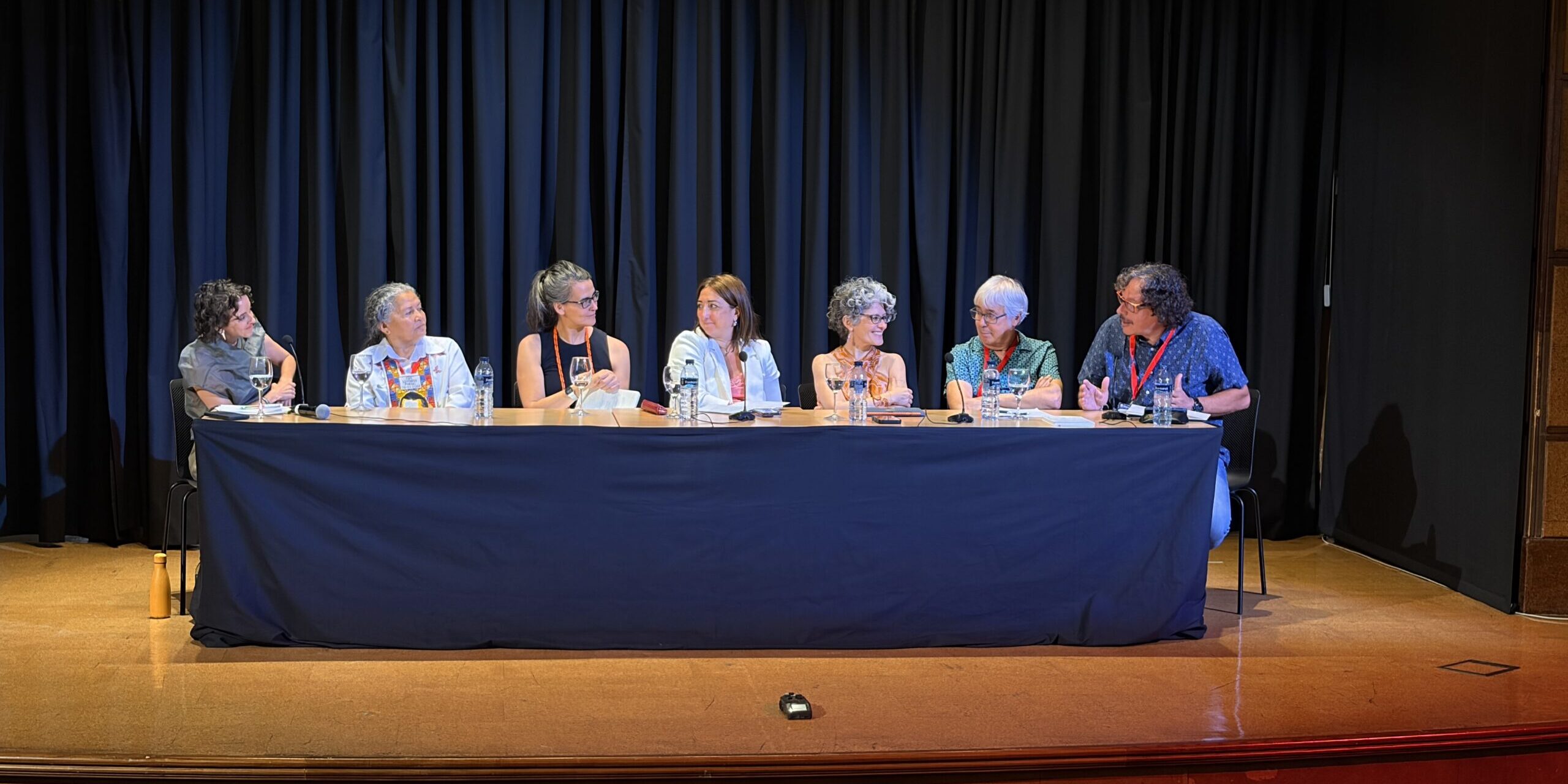
The 1st International Symposium on Participatory Memories opens today with the launch of an exhibition open to the public on 18 and 19 June
Granada, 17 June 2026 — The 1st International Symposium on Participatory Memories, “Knowledge, resistances and co-creation of futures,” opened this morning at the University of Granada, bringing together nearly 60 institutional representatives, artists, researchers and civil society organisations, mainly from Colombia and Spain.
The opening event included the launch of the Museum of Living Memories, an international exhibition featuring more than 25 projects. It will be open to the general public on Thursday 18 June, from 10:00 to 14:00 and 16:00 to 18:30, and on Friday 19 June, from 10:00 to 14:00, at the V Centenario building of the University of Granada (Faculty of Medicine, Av. de Madrid, 11). Admission is free of charge.
The symposium is the result of over a year and a half of collective work led jointly by the University of Granada and the European Observatory on Memories (EUROM) of the University of Barcelona’s Solidarity Foundation. It has been organised in collaboration with the Spain in Freedom. 50 Years programme and the Navarre Institute of Memory, and co-funded by the European Union. The Colombian Vice Ministry of Heritage, Memory and Cultural Governance has also participated in its development.
A grassroots-driven initiative
The opening session highlighted the collaborative, critical and international nature of the symposium. Margarita Sánchez Romero, Vice-Rector for University Extension at the University of Granada, underlined the role of public universities in questioning dominant historical narratives and recovering silenced memories—particularly those of women—at a time of growing challenges to democratic values.
Carmina Gustrán, Commissioner for Spain in Freedom. 50 Years, stressed the importance of building memory together with society, recognising the experiences of those who fought for rights and freedoms from grassroots contexts, and promoting initiatives that connect research, culture and civic participation.
From an international perspective, Colombian Vice Minister Saia Vergara described memory as a living, collective and contested process that requires listening, intercultural dialogue and respect for the temporalities of mourning. She also highlighted the need for decolonial approaches that recognise communities as active narrators of their own histories.
José Miguel Gastón, Director of the Navarre Institute of Memory, warned about the fragility of democratic achievements and stressed the importance of memory policies and education as tools against the rise of authoritarian discourses. He emphasised initiatives aimed at fostering intergenerational dialogue and critical thinking.
These reflections were echoed by Jordi Guixé, Director of EUROM, who recalled the origins of the project and its commitment to building international networks through horizontal collaboration. He framed memory as both a space of conflict and transformation, where shared dynamics of memorialisation emerge across different contexts and require sustained public commitment.
The symposium’s social dimension was further reinforced by Colombian activist Luz Marina Bernal, who highlighted the role of art as a tool for denunciation, healing and collective memory-making. Drawing from her experience with victims’ organisations, she stressed the importance of making pain visible and transforming mourning into shared action.
Finally, Andrea García-González, Marie Skłodowska-Curie researcher and one of the project’s coordinators, emphasised the collaborative process behind the symposium, bringing together academic, artistic, institutional and community-based knowledge. This approach has led, among other outcomes, to the creation of the Museum of Living Memories, conceived as an open space for engaging wider audiences and activating new ways of relating to the past.
The Museum of Living Memories opens to the public
The exhibition brings together more than 25 projects, primarily from Colombia and Spain, with additional contributions from Portugal, Argentina, Chile and Mexico. Its narrative is structured around three main themes: territories of memory; justice and dignities; and pedagogies of memory.
It showcases a wide range of formats, including community archives, radio projects, immersive virtual reality experiences, 3D digital reconstructions, augmented reality, collaborative mapping, participatory photography, digital memorials and community-based artistic practices.
Featured projects include Puebloagua: Amphibious Universe, a transmedia experience developed with stilt-house communities in the Colombian Caribbean; Proyecto 6402+, a digital memorial promoted by Wikimedia Colombia and MAFAPO to honour victims of extrajudicial executions; and Ruta al Exilio, an educational initiative addressing the memory of anti-Francoist exile among younger generations.
Continuing programme
Over the next two days, the symposium will address collective memory-making as a form of resistance and symbolic reparation, the aesthetics and poetics of memory, and the institutional and regulatory frameworks of public memory policies, with the aim of collectively developing a set of best practice guidelines.
The programme also includes a street-based photography workshop led by La Ampliadora Social Photography School, and a closing event on Friday combining music and audiovisual elements to evoke the memory of Cerro de San Miguel Alto, in collaboration with the local neighbourhood association.
Materials and additional information
📷 Press materials (images and visual assets)
🎥 Opening event video
📄 Full programme
🌐 Symposium blog
📱 Instagram: @memoriasparticipativas