
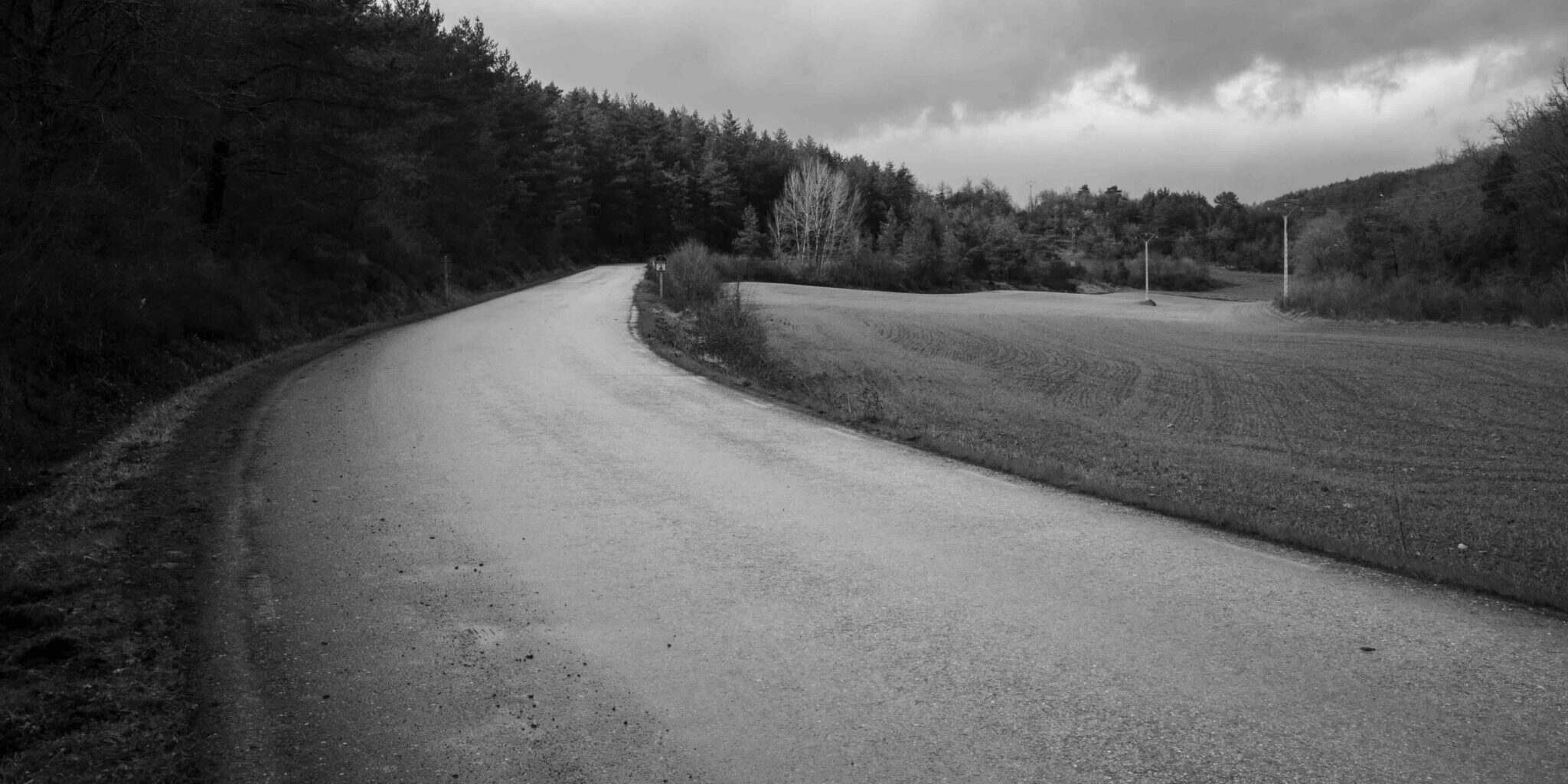
The photography exhibition The Eloquent Silence of the Landscape, by Toni Coll Tort, is presented at Espacio Tangente in Burgos, bringing into dialogue art, territory, and democratic memory.
The exhibition is curated by the European Observatory on Memories (EUROM) of the Solidarity Foundation of the University of Barcelona, as part of the commemoration “Spain in Freedom. 50 Years.”
Burgos, 13 January 2026 — The Eloquent Silence of the Landscape is the new exhibition project by photographer and democratic memory activist Toni Coll Tort. The exhibition offers an artistic and documentary reflection on the landscape as a repository of a silenced—though not forgotten—memory: that of the victims of Francoist repression buried in mass graves that have yet to be excavated in the province of Burgos.
The exhibition will open on 16 January 2026 at 8:00 pm at Espacio Tangente in Burgos, with the participation of the artist and representatives from Foro Arte y Territorio and the Coordinadora para la Recuperación de la Memoria Histórica de Burgos (CRMHB).
The project is grounded in research based on the census and map of mass graves in Castilla y León, focusing on nearly forty documented sites in Burgos where the land continues to conceal—and at the same time safeguard—the memory of the bodies that lie there. In contrast to the coldness of data and official records, the exhibition seeks to endow these places with emotion, dignity, and presence, revealing the “eloquent silence” that runs through them.
An immersive exhibition concept
The exhibition unfolds as an immersive journey through large-scale photographic projections that interpret the landscapes through the artist’s slow and attentive gaze. In an initial phase, the images are presented accompanied only by the name and location of each site, without additional contextual information beyond the essential data drawn from the memorial census.
It is in the final space of the exhibition—a symbolic recreation of the surroundings of the grave at Estépar Cemetery, where the remains of 96 individuals exhumed from one of the mass graves at Monte de Estépar now rest—that the full historical information is revealed. This curatorial gesture compels visitors to mentally retrace the journey and to revisit it with a transformed, conscious, and deeply engaged perspective.
In this way, the exhibition becomes an emotional and ethical experience, in which the landscape ceases to be a neutral backdrop and instead assumes the role of an active subject of memory.
Catalogue and box-object of triptychs
The project is complemented by the publication of a catalogue conceived as a box-object containing 38 triptychs, one for each documented site. Each piece combines landscape images with historical information and precise geolocation drawn from documentary sources, without interpretative additions.
This editorial format extends the exhibition experience and functions as an archive, an educational tool, and a device for the transmission of memory, aimed at both the general public and cultural and memorial organisations.
A project developed in collaboration with the territory
The Eloquent Silence of the Landscape is curated by Jordi Guixé, Director of the European Observatory on Memories (EUROM), and forms part of the commemorative programme “Spain in Freedom. 50 Years,” with the support of the Ministry of Territorial Policy and Democratic Memory.
The project has been developed in close collaboration with organisations dedicated to the recovery and dignification of democratic memory and is supported by the Coordinadora para la Recuperación de la Memoria Histórica de Burgos (CRMHB), Espacio Tangente, the European Observatory on Memories (EUROM), and Foro Arte y Territorio. This network of collaborators positions the exhibition as a space for critical reflection on the recent past, democracy, and public memory policies.
Related graphic materials: https://flic.kr/s/aHBqjCE3Ec