
The III International Congress on History with Memory in Education will take place in Pamplona/Iruña on 12, 13 and 14 November 2026, bringing together a diverse community of educational professionals, students, researchers and memory practitioners. The European Observatory on Memories (EUROM) is collaborating on this initiative, which promotes dialogue and cooperation around historical memory in educational settings.
More than three years after the first edition was held in November 2022, the congress has become part of a growing network of educational actors committed to integrating historical memory into teaching and learning. What began as an opportunity to assess educational practices and exchange experiences has developed into a broader community connected through RedMemoria, a network established following the first congress to foster collaboration across educational institutions and territories.
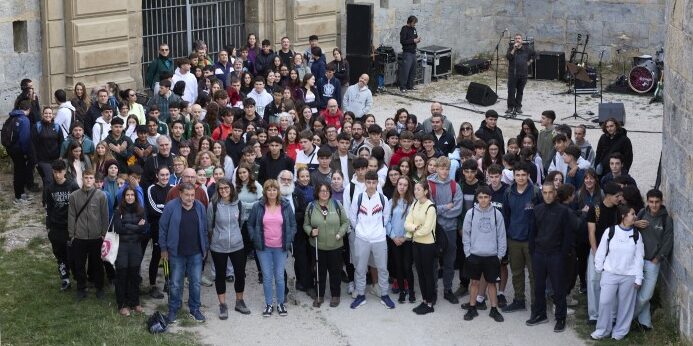
This process continued in 2025 with the first RedMemoria gathering, which brought together students and teachers from 23 educational centres across 12 Spanish autonomous communities. The meeting combined visits to memory sites in Navarre with workshops and discussions on educational practices, the role of historical memory in young people’s lives, and the future of collaboration within the network.
Connecting historical memory with the challenges of the present
The third congress aims to consolidate the experience accumulated so far while critically examining established practices and addressing new questions emerging from today’s political and social context. Its approach emphasises the importance of developing educational responses that go beyond reacting defensively to challenges and instead offer constructive ways to strengthen historical understanding and democratic engagement.
The programme welcomes contributions based on educational experiences developed in schools and other learning environments, particularly projects involving local communities or cooperation between educational centres. It also encourages dialogue between formal education — from early childhood education to universities and vocational training — and non-formal education, civil society organisations, and initial and continuing teacher training.
Students are expected to play a prominent role in this edition, building on the positive experiences of previous congresses and the RedMemoria gathering, with an emphasis on active participation and young people’s own perspectives on the significance of historical memory.
Alongside established areas of interest, such as memory sites and heritage, historical sources, feminism, subaltern groups as historical subjects, and teacher training, the congress will address questions that have gained particular urgency in the present. These include pacifism and antimilitarism amid growing militarisation in political discourse and international relations; past and present struggles for civil, social and economic rights; neighbourhood movements; colonial pasts and presents; the relationship between memory and democracy; approaches to the recent past; and young people’s engagement with history through digital media and social networks.
The congress also seeks to strengthen transnational cooperation among educational networks, extending dialogue beyond Spain to include partners from Southern Europe and Latin America.
By connecting educational practice, historical research and public engagement with the past, the III International Congress on History with Memory in Education offers an opportunity to share experiences, develop collaborative approaches and reflect on how memory education can contribute to democratic societies.
Survey
This activity is co-financed by the European Commission and for its evaluation we kindly ask your collaboration in filling out this survey. You will need the information indicated below. Thank you very much!
- Reference of the Project: 101236354
- Type of activity: Awareness Raising
- Title: Networking
- Date: November 12-14, 2026
- 3 Days
- In Person Event
- Pamplona (Spain)