
Antigypsyism, or anti-Roma discrimination, is a deeply rooted and persistent form of racism that continues to affect Roma communities across Europe. In educational contexts, it often manifests through stereotypes, prejudice and hate speech, impacting not only Roma students but also the broader climate of coexistence and social cohesion in schools.
This new edition fo the EUROM series Current Perspectives on Memories responds to the urgent need to address these challenges through education. Drawing on the field of historical memory and memory pedagogies, it offers teachers and educational professionals tools to better understand the origins and continuity of antigypsyism, while fostering critical, inclusive and transformative learning environments.
With a focus on both the specificity of the genocide perpetrated against Roma communities under the Nazi regime and the ongoing struggle for its recognition, the course adopts a practical and didactic approach. Participants will gain concrete strategies to identify and challenge hate speech and discrimination, while promoting historical awareness, critical reflection and social justice in their teaching practice.
The seminar is organized in collaboration with CESIRE (Department of Education of the Government of Catalonia) and is certified by the Institute for Professional Development (IDP-ICE) of the University of Barcelona. Registration is free of charge and is now available throughout this link. Simultaneous translation into English will be available in all sessions.
Agenda
Session 1 | 29/04/26, from 16:30 to 18:00
A general approach to the history and memory of the Roma people
Anabel Carballo Mesa (FAGiC)
Session 2 | 06/05/26, from 16:30 to 18:00
Flamenco music as an instrument of transmission of the culture of the gypsy people
Gonzalo Montaño Peña (Independent Researcher)
Session 3 | 13/05/26, from 16:30 to 18:00
Roma culture and strategies to combat antigypsyism
Merdjan Jakupov (Amaro Drom)

Objectives
The workshop aims to:
-
Understand antigypsyism as a historical, social and cultural phenomenon, and identify its contemporary manifestations.
-
Equip teachers with pedagogical tools to detect and counter hate speech, racism and xenophobia related to anti-Roma discrimination.
-
Explore the potential of historical memory and memory pedagogies to promote critical and inclusive citizenship.
-
Develop practical resources and learning activities transferable to classroom practice.
Contents
The course will address:
-
The history and memory of Roma communities in Barcelona, Spain and Europe, including persecution, discriminatory policies, resistance and cultural contributions.
-
Past and present forms of discrimination: structural, institutional and social antigypsyism, as well as persistent stereotypes and narratives.
-
Memory as a pedagogical tool to foster critical thinking, empathy and inclusion.
-
The role of Roma music—particularly the Romani Caló tradition—as a vehicle of memory, identity and community cohesion.
-
Hate speech and xenophobia in educational settings: identification, analysis and response strategies.
-
The design of learning situations that address antigypsyism and other forms of discrimination from a human rights and critical citizenship perspective.
Methodology
The workshop consists of three online sessions of 90 minutes each, led by experts in Roma history and memory, memory pedagogies and anti-racism education.
Each session combines a lecture introducing key concepts with interactive discussion spaces. Through real cases, guided questions and shared experiences, participants will engage in critical reflection and collaborative learning.
About the trainers
David González Vázquez (EUROM – Academic Coordination)
Project officer at EUROM and adjunct professor at the University of Girona, specialising in heritage education and memory studies, with a multidisciplinary focus on sites of memory.
Anabel Carballo Mesa (FAGiC – Teaching Coordination)
PhD candidate in Contemporary History at the University of Barcelona and executive director of the Federation of Gypsy Associations of Catalonia. Her work focuses on Roma memory and anti-Roma discrimination, including participation in the Dikh He Na Bister initiative.
Gonzalo Montaño Peña (Independent Researcher)
Musicologist and cultural activist specialising in flamenco and Roma cultural heritage. His work highlights Roma song as an oral archive of collective memory and identity.
Merdjan Jakupov (Amaro Drom)
Managing Director of Amaro Drom, a Roma youth organisation in Berlin, Germany. His work centres on combating anti-Roma discrimination, promoting human rights education and fostering youth participation.
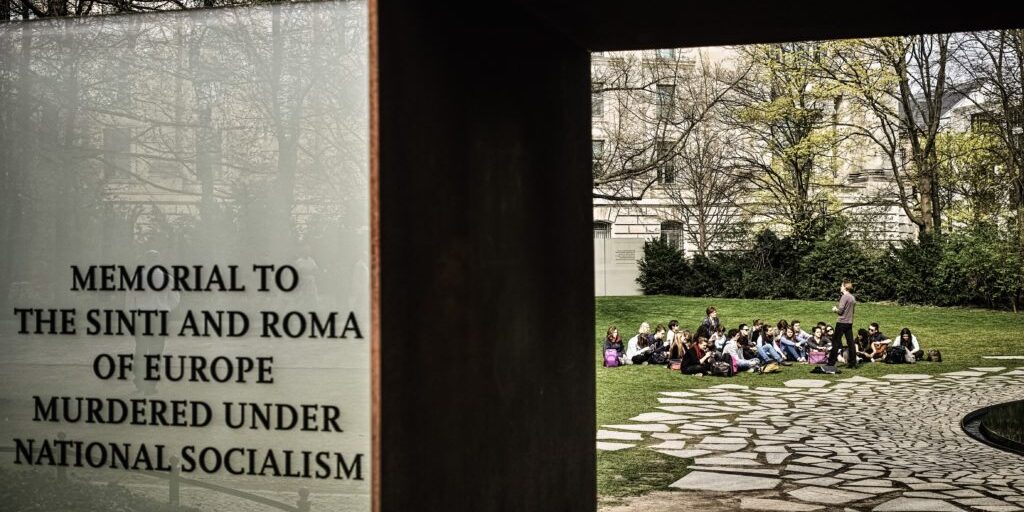
Cover picture: Memorial to the murdered Sinti and Roma of Europe. © Foundation Memorial. Photo: Marko Priske
Survey
This activity is co-financed by the European Commission and for its evaluation we kindly ask your collaboration in filling out this survey. You will need the information indicated below. Thank you very much!
- Reference of the Project: 101236354
- Type of activity: Training
- Title: Current Perspectives on Memories 2026
- Date: April 29, 2026
- Online event