
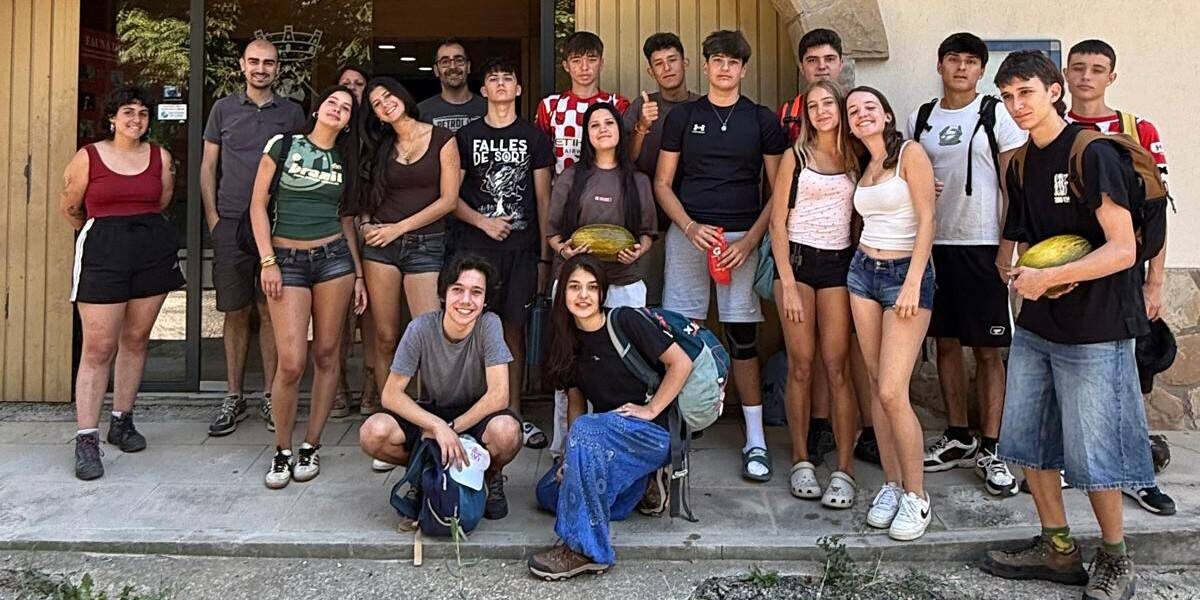
Fourteen young people aged 14 to 17 have taken part in the second edition of the work camp on the memory of forced labour along the Coll de Jou–Pont d’Espia road, in the Catalan region of Solsonès. Combining archaeology, historical research, and democratic memory, the initiative invites participants to uncover the history of one of the infrastructures built during the post-war period under the Franco dictatorship’s forced labour system.
Based in the village of Cambrils (Odèn), participants worked alongside archaeologists from the University of Barcelona to excavate the only surviving workers’ barracks associated with the construction of today’s C-401 road. The fieldwork, carried out between 9 and 17 July, forms part of a broader research project that seeks to document the experiences of those compelled to build roads and other public infrastructure during the early years of the dictatorship.
During the presentation of the project, M. Claustre Sunyer, President of the Solsonès County Council, stressed that the camp represents “much more than an archaeological intervention,” describing it as an opportunity for young people to engage directly with the history of the region while helping preserve a collective memory that deserves to be known and shared. She also thanked the many institutions and professionals whose collaboration has made the initiative possible.
Sara Vilches, Councillor for Culture at the Solsonès County Council, highlighted the importance of recovering a history that had long remained untold. She also recalled the success of the first edition of the camp, whose discoveries—including personal belongings linked to former workers—opened new avenues for historical research.
The archaeological campaign is directed by historian and archaeologist Nil Boix, who explained that this year’s excavation builds on the research initiated in 2024. Among the artefacts recovered are footwear, horseshoes, iron tools, and everyday objects that offer valuable insights into the living and working conditions on the site. According to the research conducted so far, the excavated barracks appear to have housed compulsory civilian workers rather than political prisoners, providing a more nuanced understanding of the labour system used during the construction of the road.
The Coll de Jou–Pont d’Espia road is one of many infrastructures built during the post-war years through Francoism’s coercive labour system, which affected more than 110,000 people in the early 1940s. By combining fieldwork with historical interpretation, the work camp encourages younger generations to engage critically with this often-overlooked chapter of Spain’s recent past and to reflect on the importance of preserving democratic memory.
The initiative is promoted by the Solsonès County Council, the Centre d’Estudis Lacetans, the European Observatory on Memories (EUROM) of the University of Barcelona, the Rural Coordination of Catalonia, and the Municipality of Odèn, with the support of the Memorial Democràtic, the Institut d’Estudis Ilerdencs, and the Government of Catalonia.