
“Twisting the Past” brings together scholars and digital creators at the Faculty of Geography and History to discuss how to confront manipulation and denial of the past. The event invites reflection on how to defend democratic memory in an era of misinformation and revisionist narratives.
Download the press release in Catalan and Spanish.
Barcelona, 21 October 2025 – In a context marked by the rise of denialist attitudes and the manipulation of historical narratives, the European Observatory of Memories (EUROM) — a project of the Fundació Solidaritat of the University of Barcelona — is organizing the international conference “Twisting the Past: Questioning Historical Revisionism”. The event provides a space for critical reflection on the current challenges to democratic memory.
The conference, held at the Faculty of Geography and History of the UB, is part of the European project Power of Personal Stories Confronting Oblivion and is organized in collaboration with España en Libertad. 50 años Commissioner and the Center for International Historical Studies (CEHI) of the University of Barcelona.
Throughout the day, discussions will address topics such as the connections between Francoism and the Holocaust, historiographical debates on the Spanish Civil War and the dictatorship, and the role of social media in transmitting historical knowledge. The program includes a keynote lecture by Professor Xosé M. Núñez Seixas (USC), panel discussions with Santiago López Rodríguez (Uppsala University), César Rina Simón (UNED), Marta Simó (UAB), Josefa Mesa, and Mikel Herrán, and the presentation of the book FRANCOFACTS: Debunking the Fake News about Francoism with author Fernando Hernández Sánchez (UAM), moderated by Paola LoCascio (UB).
A dialogue between academia and society
Through this conference, the EUROM reaffirms its commitment to putting knowledge at the service of democratic memory, promoting active resistance to pseudo-historical revisionism through research, critical education, and rigorous dissemination, while strengthening dialogue between academia and society to prevent the trivialization of the past. The event will count with the participation of 16 scholarship students, thanks to the collaboration between EUROM and the España en Libertad. 50 años Commissioner in the framework of the Interuniversity Master in Contemporary History, coordinated by the University of Granada.
The morning will open with the panel “Francoism and the Holocaust”, moderated by Marta Simó (UAB), a specialist in Holocaust memory and public memory policies. The session will address the relationship between the Francoist regime and the persecution of Jews in Europe, a topic often overlooked in Spanish historiography.
Santiago López Rodríguez (Uppsala University) will present the lecture “Eighty Years Later… Francoism and the Holocaust from Historical Research”, examining the regime’s attitudes and positions regarding Nazi extermination. César Rina Simón (UNED) will analyze “Normalization and Uses of Antisemitism during the Second Republic and Francoism”, exploring how antisemitic prejudices were integrated and instrumentalized within official Francoist discourse.
The conference’s keynote lecture will be delivered by Xosé M. Núñez Seixas (University of Santiago de Compostela), a leading historian in the comparative study of European nationalisms and war memories. Under the title “Uses and Abuses of Historiographical Revisionism: Francoism in Comparative Perspective”, Núñez Seixas will examine how the Francoist regime has been reinterpreted in different political and cultural contexts, highlighting the connections between revising the past and contemporary identity debates. The session will be presented by Queralt Solé (University of Barcelona), a specialist in historical memory and Francoist mass graves.
Social media has become a key arena in the struggle for memory. The panel “New Channels of Knowledge Transmission: Threats and Opportunities”, moderated by Laia Gallego (UB), will analyze how historical narratives circulate, transform, and often become distorted on digital platforms.
Josefa Mesa (@josefinetable) will discuss the intersection of historical memory and the far right online in “Franco Never Tweeted and Now He’s a Trending Topic: Historical Memory, the Far Right, and Social Media”, while Mikel Herrán (@putomikel) will reflect on new forms of national-Catholic populism and their presence in digital culture.
The conference will conclude with the presentation of the book FRANCOFACTS: Debunking the Fake News about Francoism (Ediciones Pasado y Presente, 2025), a work combining historical research and critical dissemination to combat misinformation about the dictatorship. Authors Fernando Hernández Sánchez (Autonomous University of Madrid), historian specialized in the Civil War and Francoism, and Pedro Vera, illustrator and satirical cartoonist, will discuss how false narratives about the regime are created and persist. The session will be presented and moderated by Paola LoCascio (University of Barcelona), Associate Professor of Contemporary History and expert in political cultures of the 20th century.

More pictures on Flickr.
About the Speakers and Moderators
Marta Simó
PhD in Sociology from the Autonomous University of Barcelona (2018), Marta Simó is a specialist in Jewish identities and the Holocaust. Since 2012, she has been a researcher at the ISOR group and a member of several international working groups on the Holocaust, exile, and deportation. She has collaborated with institutions such as the Memorial Democràtic and the Department of Education of the Government of Catalonia, as well as with the International Holocaust Remembrance Alliance (IHRA).
Santiago López Rodríguez
Historian and PhD in History from the University of Extremadura, with a dissertation titled Spanish Foreign Office during the Holocaust in Occupied France (1940–1944). He has been a lecturer at the University of Extremadura and a visiting researcher at the Complutense University of Madrid and the École des Hautes Études en Sciences Sociales in Paris. He is currently a postdoctoral researcher at the Hugo Valentin Centre for Holocaust and Genocide Studies at Uppsala University.
César Rina Simón
Associate Professor of Contemporary History at the National Distance Education University (UNED), he holds a PhD from the University of Navarra with the thesis Iberismos: proyecciones, anhelos y expectativas peninsulares, 1848‑1898. His research focuses on the construction of Francoist memory, popular religiosity, and the relationship between religious imaginaries and political legitimacy.
Xosé M. Núñez Seixas
Born in Ourense in 1966, Xosé M. Núñez Seixas is a Full Professor of Contemporary History at the University of Santiago de Compostela. He specializes in the study of nationalism, the cultural history of war and violence, and migration studies. He has also taught at Ludwig Maximilian University of Munich and served as Vice-President of the Galician Council of Culture.
Queralt Solé
PhD in Contemporary History from the University of Barcelona, Queralt Solé is an Associate Professor in the Department of History and Archaeology. Her research focuses on the Spanish Civil War and Francoism, with particular attention to mass graves and the disappeared.
Laia Gallego
Researcher and Adjunct Lecturer in the Department of History and Archaeology at the University of Barcelona. Her academic work focuses on contemporary history, with a particular interest in memory and identity dynamics.
Josefa Mesa
Researcher and activist in the field of historical memory. Through her social media account @josefinetable, she shares content on historical memory, the far-right, and social media, combining critical analysis with accessible public engagement.
Mikel Herrán (PutoMikel)
Known online as PutoMikel, he is an archaeologist, YouTuber, writer, and drag performer. Through his YouTube channel, he combines historical rigor with humor to engage younger audiences, addressing topics such as colonial legacies and the Spanish Inquisition. His book Sodomitas, Vagas y Maleantes explores the history of the LGBTQ+ community in Spain.
Fernando Hernández Sánchez
Professor of Contemporary History at the Autonomous University of Madrid, he is an expert in historical memory and has published extensively on Francoism and Spain’s democratic transition.
Paola LoCascio
PhD in Contemporary History from the University of Barcelona, Paola LoCascio is an Associate Professor in the Department of History and Archaeology. Her research focuses on the history of memory and the construction of historical narratives in contemporary Spain.
Follow the event on social media:
@euromemories
@50enlibertad
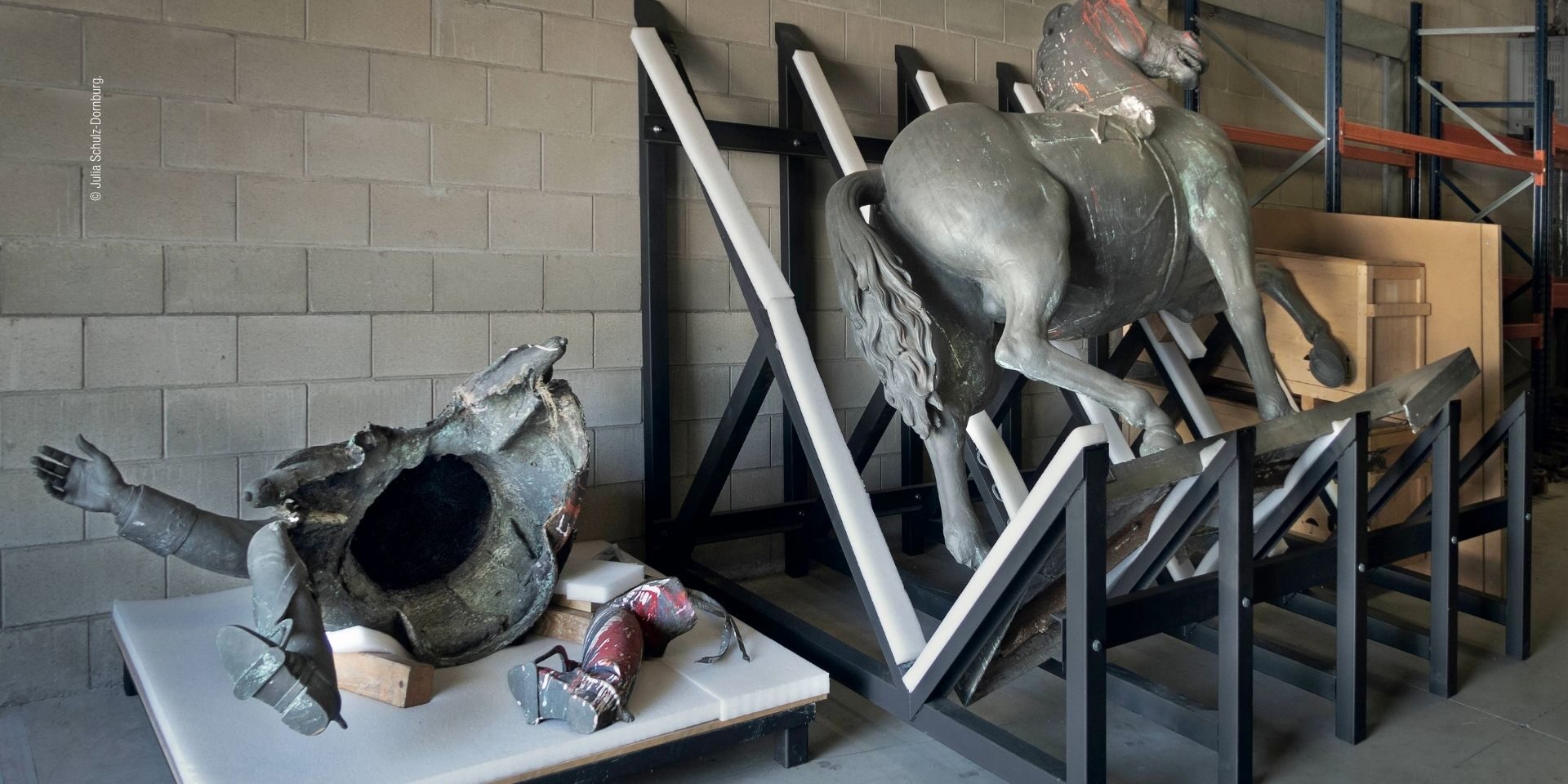
Cover image: Equestrian statue of Franco, held in the storage facilities of the Museum of History of Barcelona (MUHBA) after the exhibition “Franco, Victory, Republic: Impunity and Urban Space” (El Born CCM, 2016). Photograph © Julia Schulz-Dornburg.