
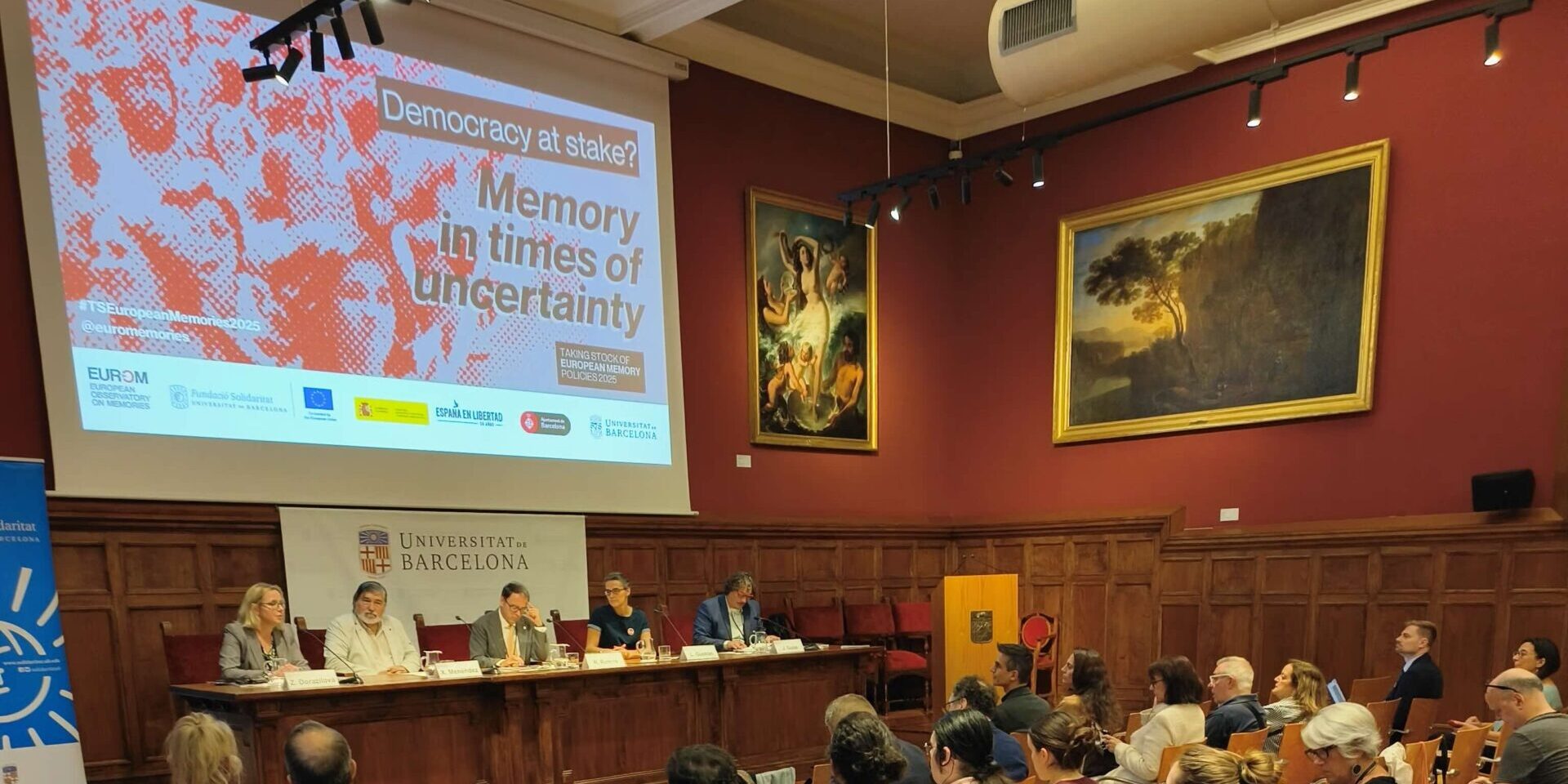
The European Observatory on Memories (EUROM) holds its eighth annual meeting, “Democracy at stake? Memory in times of uncertainty,” on 9–10 October at the Historic Building of the University of Barcelona. The event brings together academics, journalists, practitioners and Members of the European Parliament to explore how memory work can strengthen democracy amid global crises, social polarization, and the rise of populism.
Welcome Session: A Call for Active Engagement and Democratic Resilience
Opening the event, representatives from the organizing entities emphasized the need to strengthen democracy through participation and critical reflection.
Jordi Guixé, EUROM Director, opened this hybrid meeting by highlighting its participatory nature:
“We don’t just observe — we participate,” he said, pointing to the global context of wars, atrocities, and rising populisms, with a special mention of the genocide in Gaza. Guixé urged the audience to revisit past crises to reclaim foundational values such as the welfare society, and reflected on emerging challenges including artificial intelligence and the idea of a federation of countries.
Zuzana Dorazilová, representing the Citizens, Equality, Rights and Values (CERV) programme of the European Commission, recalled that the European project was built “on the memory of the Holocaust” and the commitment to “never again.” She warned that democracy is under pressure, outlining key EU initiatives such as the EU Democracy Shield and the Center for Democratic Resilience:
“The best defenders of democracy are free citizens,” she affirmed, emphasizing fact-checking, civic education, and local participation in events such this one as essential democratic tools.
Carmina Gustrán, Commissioner for the commemoration “Spain in Freedom. 50 years,” underscored that memory is democracy, calling for recognition and public debate on Spain’s democratic transition.
“Knowing the past is a commitment to the future,” she said. “Europe is a community of memory — open, generous, and free.”
Representing the Government of Catalonia, Xavier Menéndez, Director-General for Democratic Memory, reaffirmed institutional support for EUROM’s mission and the importance of defending democratic health through research and reflection.
“These are times of uncertainty and resistance,” he said. “That is when democratic values matter most.”
Finally, Raul Ramos, Vice-Rector for Internationalisation Policy at the University of Barcelona, congratulated the organisers for bringing together representatives from all sectors. He highlighted the 1978 photograph of youth mobilising for rights and against unemployment, chosen to illustrate the programme, interpreting it through the lens of today’s social challenges.
“Then as now, young people continue to mobilise — today for decent wages and a dignified future.”
Programme Highlights
The inaugural session featured lectures by:
- Georges Mink, emeritus researcher at the CNRS and professor at the College of Europe (Natolin), on memory at the European level.
- Matilde Eiroa San Francisco, scholar at the Carlos III University of Madrid, on the management of the Francoist legacy in Spain.
The keynote lecture, “Rethinking memory work and the European narrative,” will be delivered by Géraldine Schwarz, Franco-German journalist and writer, on Thursday, 9 October at 3:30 p.m.
On Friday, 10 October at 10:00 a.m., a round table with Members of the European Parliament — Ana Miranda Paz, Diana Riba, Jaume Asens, and Juan Fernando López Aguilar — will explore the future of European memory policies, moderated by Marije Hristova, postdoctoral researcher at the Spanish National Research Council (CSIC) and expert in exhumations and transnational memory policies.
Organisers and Partners
This edition of the EUROM Annual Meeting is organised by the European Observatory on Memories (EUROM) of the Solidarity Foundation of the University of Barcelona, in collaboration with the Commissioner for the commemoration “Spain in Freedom. 50 years”, and supported by the Barcelona City Council and the European Union’s Citizens, Equality, Rights and Values (CERV) programme.
Practical Information
University of Barcelona Historical Building
9–10 October 2025
Free access
