
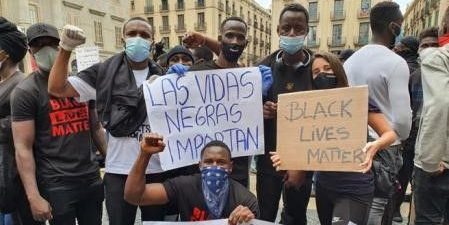
The latest report of the United Nations High Commissioner for Human Rights on racial justice and reparations highlights the growing international momentum to address the legacies of slavery and colonialism. Among its references, the report cites the study published by the European Observatory on Memories (EUROM), Reparation for colonialism and slavery in Spain, coordinated by historians Celeste Muñoz Martínez (UNED) and Oriol López Badell (EUROM).
The High Commissioner’s report, which will be formally presented to the Human Rights Council on 1 October 2025, examines the persistent legacies of slavery, the transatlantic trafficking of enslaved Africans, and colonialism. It stresses the responsibility of states and other actors to dismantle systemic racism and advance reparative justice.
The document underlines that reparative justice should be:
-
Context-specific and intersectional
-
Anchored in international human rights law
-
Designed with the genuine participation of Afro-descendant communities
Furthermore, the report calls for renewed leadership, strengthened networks, and broad-based societal mobilization to generate effective and sustainable responses to systemic racism.
“The inclusion of EUROM’s work in this report highlights the relevance of addressing Spain’s colonial past within a global framework of justice and equality,” stated Jordi Guixé, EUROM director. “This recognition reinforces our commitment to critical research and public dialogue on memory, historical responsibility, and reparations.”
Official Presentation
The High Commissioner’s report will be presented before the UN Human Rights Council on 1 October 2025, from 3:00 pm to 4:45 pm CEST. The session will be broadcast live on UN Web TV.
This acknowledgment by the United Nations reflects the international significance of EUROM’s research and its contribution to advancing critical debates on colonialism, slavery, and racial justice.
Report of the United Nations High Commissioner for Human Rights
A/HRC/60/70: Promotion and protection of the human rights and fundamental freedoms of Africans and of people of African descent against excessive use of force and other human rights violations by law enforcement officers through transformative change for racial justice and equality /