
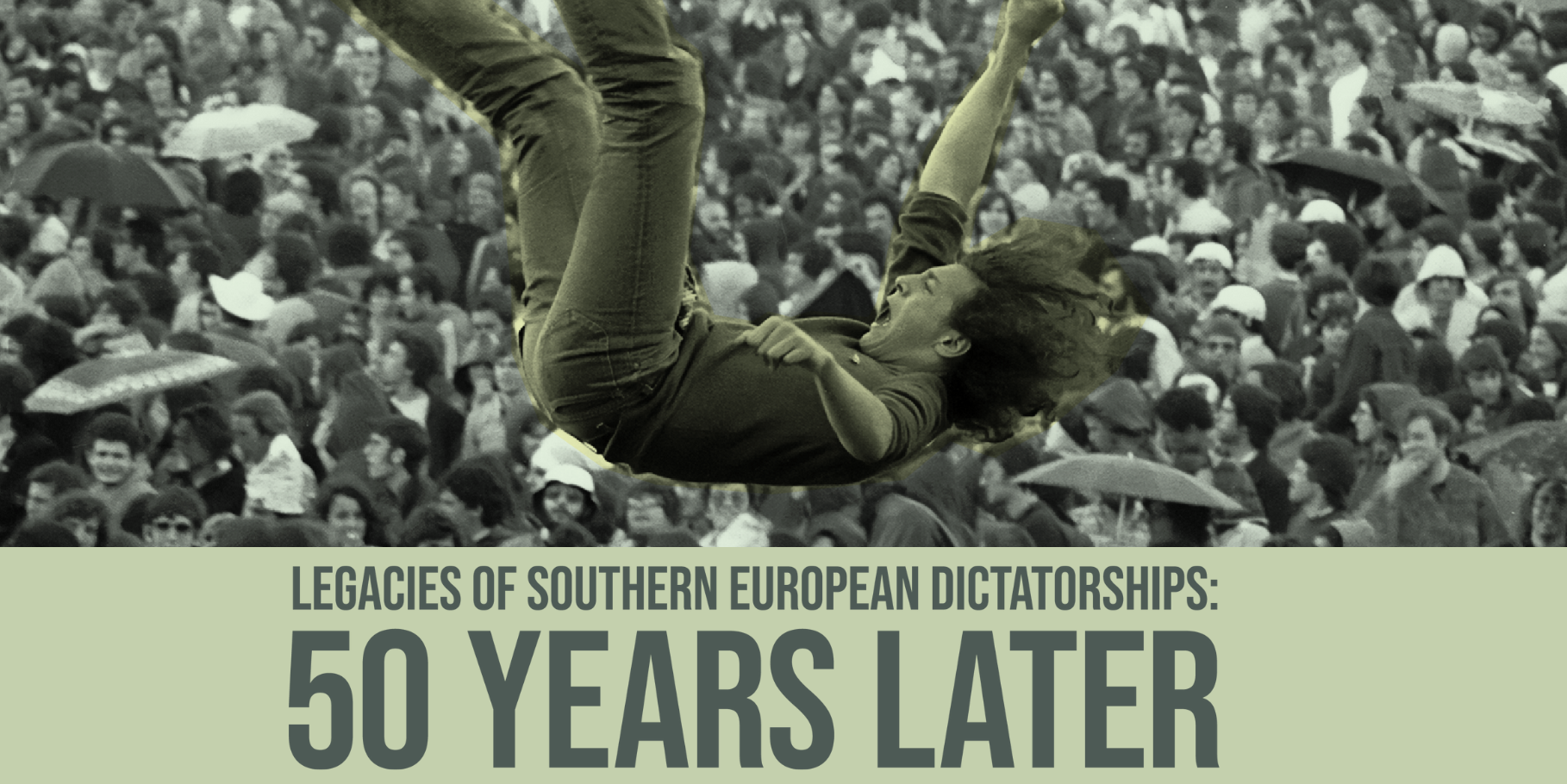
The multidisciplinary event “Legacies of Southern European Dictatorships: 50 Years Later,” held at the House of European History, invites audiences to confront the legacies of the recent past and imagine more just and democratic futures.
Fifty years after the death of Francisco Franco and Spain’s transition to democracy, the House of European History will host the event Legacies of Southern European Dictatorships: 50 Years Later, a multidisciplinary programme exploring how the authoritarian past continues to shape Europe today.
Organized by the European Observatory on Memories (EUROM) of the University of Barcelona and the House of European History, the event is part of the commemorative programme “España en LIbertad. 50 años” and is supported by Spain’s Ministry of Territorial Policy and Democratic Memory and the Ministry of Culture.
Taking place on November 18, the event will bring together historians, artists, curators, memory practitioners, students, and policymakers to examine the enduring legacies of fascist and military regimes in Spain, Portugal, and Greece. The discussion will highlight how the democratic transitions that followed the end of the dictatorships paved the way for these countries’ subsequent accession to the European Union.
Through debates, artistic interventions, and exchanges, participants will address how to communicate the violence of the past to new generations, the role of dissonant heritage in democratic culture, and how European experiences can inspire new strategies for remembrance and resistance.
Sixteen young participants from the Youth and Memory Engagement Conference will also take part, bringing intergenerational perspectives to the discussion.
Highlights
The programme will feature the roundtable “Re-signifying European Dissonant Heritage. Lessons to be Learned for the Spanish Cases,” exploring European sites of contested memory as inspiration to reinterpret dissonant heritage in Spain, chaired by Paco Ferrándiz (CSIC). Speakers include Ayoko Mensah (House of European History), Rita Rato (Museu do Aljube, Portugal), Christian Dürr (Mauthausen Memorial), and Magda Fytili (ASKI, Greece).
Participants may also join a curated tour of the exhibition Presence of the Past, introduced by Simina Badica and guided by Dora Ivanova, Marije Hristova, Anne Thomas, and Chantal Kesteloot. The day will close with Exilio, a multilingual performance by Nora Buschmann and Alex Brendemühl, reflecting on exile in Europe. Participation is free of charge; however, places are limited and advance registration is required.
The full programme is available here. Participation is free of charge; however, places are limited and advance online registration is required.