Guillermo León Cáceres, National Distance Education University (UNED)
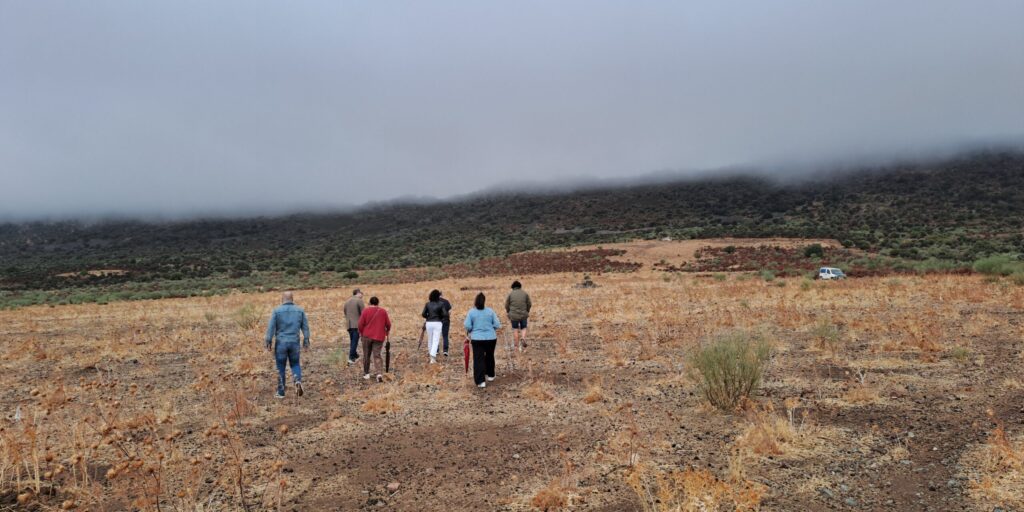
Cover image: A Travelling Seminar with the EUROM Team and AMECADEC (2024). Photograph: EUROM
A Brief History of Castuera Concentration Camp
In March 1939, as the Spanish Civil War drew to a close, the Francoist military authorities built a concentration camp for prisoners on the outskirts of Castuera (Badajoz). During the single year it remained operational, between 9,000 and 15,000 prisoners are estimated by historians to have passed through its gates. Those detained there were not only soldiers belonging to Republican units stationed on the Extremadura Front at the end of the war, but also civilians with political or trade-union ties to the Republican cause.
The camp occupied an irregular seven-hectare plot, surrounded by a ditch and double barbed-wire fence. Within it stood eighty prefabricated wooden barracks aligned along cobbled streets, a central square dominated by a cross on a concrete plinth where prisoners were assembled, a washhouse, latrines, and an area for isolated detainees.
Within the broader Francoist repressive system, the camp served three main functions: classification, re-education, and repression. Prisoners were classified into four categories:
A: those not considered enemies of the state;
B: those disaffected with the regime but without political or social responsibility;
C: Republican leaders and high-ranking officers;
D: common criminals.
Those assigned to category C were handed over to the Military Justice system, which, through summary courts-martial devoid of even the most basic legal guarantees, routinely sentenced them to death or long prison terms.
“Re-education” consisted largely of crude military and religious harangues designed to break the prisoners’ will. Repression took multiple forms: extrajudicial removal of detainees for execution, beatings, severe deprivation, and a generalised, arbitrary exercise of violence within the barbed-wire enclosure.
Daily life was marked by misery. The diet consisted of a watery soup, a piece of bread, and a tin of sardines shared between two people. This inadequate sustenance led to widespread malnutrition, which, compounded by poor hygiene, caused illness and death among many prisoners. They slept crammed into the wooden barracks, each 15.5 metres long and 4.5 metres wide, holding several dozen inmates.
The camp’s first commandant was Ernesto Navarrate Alcal, who remained in charge until June 1939. Known for his cruelty during the war, Navarrate facilitated repression by Falangist groups. Numerous testimonies describe how Falangists from different towns would visit the camp to remove left-wing leaders from their own localities, taking them away illegally. Many of these prisoners were never seen again. The best-known case is that of José González Barrero, socialist mayor of Zafra during the Second Republic.
However, these illegal extractions were not random acts of violence but were orchestrated by the Servicio de Información y Policía Militar (SIPM) — the Military Information and Police Service — which played a central role in repression during and immediately after the war. Acting on SIPM orders, political and trade-union leaders from the Popular Front, along with Republican army officers, were placed in the isolation area of the camp — the final stop before execution.
Material evidence of these killings came to light in 2011, when the Asociación Memorial Campo de Concentración de Castuera (AMECADEC) located and exhumed a mass grave in the town cemetery. Although today the grave lies within the cemetery grounds, in 1939 it was just behind it, beside the path leading to the camp. Twenty-three victims were exhumed, and personal belongings confirmed that they had come from the concentration camp.
Nearby stood La Gamonita mine, a disused lead mine since the early twentieth century, at whose foot the camp had been built. The mine contained a deep vertical shaft, and survivor testimony tells of a brutal execution method known as “la cuerda india” — “the Indian rope.” Prisoners, bound together in a line, were led to the edge of the mine, which was covered by a trapdoor. The door was opened, the prisoners plunged into the shaft, and a hand grenade was then thrown after them.
The memory of Castuera Concentration Camp: actors, achievements and horizon
Castuera camp was symbolically “liberated” in April 2005 during the first tribute to its victims — an event organised by local citizens, some linked to the Izquierda Unida political group. Several of these organisers later became founding members of AMECADEC, established in 2006. These “memory entrepreneurs” contacted victims’ families and surviving prisoners, and, drawing on the research published in the 2006 monograph Cruz, bandera y caudillo. El campo de concentración de Castuera, succeeded in placing the camp’s significance as a Site of Memory firmly in the public sphere.
The memorial importance of Castuera camp lies in the fact that the fate of many detainees remains unknown. It is certain that they entered the camp, yet their subsequent whereabouts are lost. For families of the disappeared, the site itself has become a symbolic grave: they bring flowers to the ruins because it is the last physical point of reference they have for their loved ones. Since its founding, AMECADEC has pursued three main lines of work, with the camp as its focal site and human rights as its overarching theme:
1. Providing support to victims of Francoist repression, especially those linked to the camp;
2. Paying tribute to the victims through commemorative acts; and
3. Protecting, preserving, and promoting knowledge of the site and its history.
The land on which the camp stood is privately owned. In 2008, the owner announced plans to build a photovoltaic solar plant that would have destroyed the remaining material traces of the camp. Upon learning of the project, AMECADEC alerted the regional authorities and mobilised civil society and historians to denounce the threat. The plan was eventually modified, and the solar installation now encircles part of the camp’s perimeter rather than covering it.
In response to these public demands, the Regional Government of Extremadura declared the site a Property of Cultural Interest (Bien de Interés Cultural) in May 2009, under the legal category ofHistoric Site. This designation, regulated by heritagelegislation, obliges the regional administration toensure the protection and conservation of such sites.

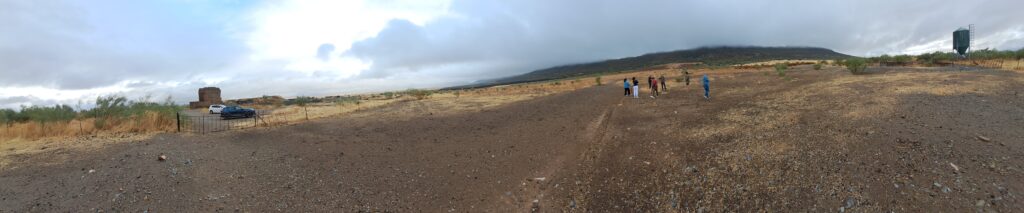
Winding tower of La Gamonita mine and, in the background, part of the photovoltaic installation. Photograph: AMECADEC
The decree published in the Official Gazette of Extremadura on 13 May 2009 stated: “Castuera concentration camp is a reference point for historical memory and a place of remembrance for many individuals and groups. Its historical significance within the framework of Francoist repression, linked to the Civil War and its aftermath, makes it a regional symbol deserving of the highest recognition and protection, which is hereby granted by this decree.”
Among AMECADEC’s most emblematic commemorative activities is the March to the Concentration Camp, held annually since 2006. The event is scheduled for a weekend in early April, close to the anniversary of the proclamation of the Second Republic on 14 April 1931. It combines educational and memorial activities: lectures on memory, history
and human rights, and a collective walk from the town centre to the camp site.
This march — undertaken on foot — represents a form of “pilgrim memory”, retracing in reverse the route prisoners once followed when taken from the camp to give statements in town. It ends at the former camp square, beside the concrete plinth where the cross once stood. During the ceremony, a mast is raised, and the Republican flag is hoisted. Flowers are laid in remembrance, the AMECADEC Manifesto is read aloud, and citizens, relatives, poets and musicians are invited to speak or perform.
The association’s third line of work focuses on the dissemination of the camp’s history and memory. AMECADEC has produced a range of educational and outreach materials for public use. The exhibition The System of Francoist Concentration Camps: Castuera Camp has travelled across Extremadura, and a dedicated teaching unit has been distributed to schools. These initiatives are complemented by guided visits, both for local and international visitors, though the majority of participants are secondary-school students from across the region.
The memorial narrative surrounding Castuera camp has thus been shaped primarily by civil society, led by AMECADEC, since public institutions have yet to implement a consistent policy of dissemination or education. Although a musealisation project has been proposed by the regional government, it remains unfulfilled to this day.
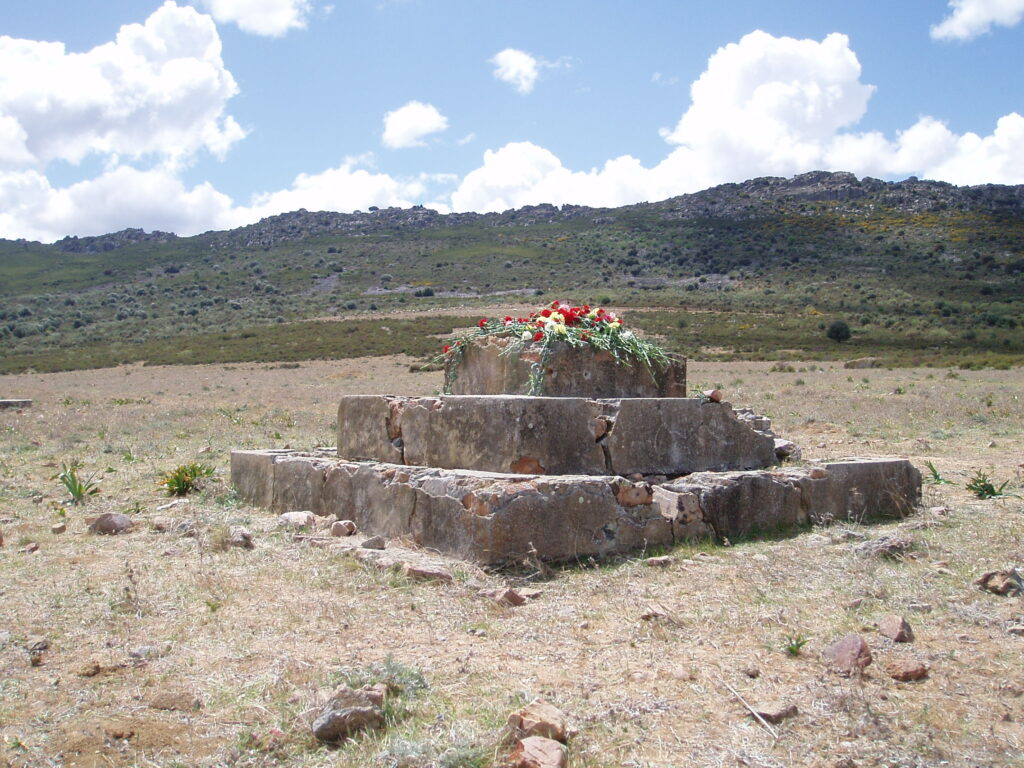
The pedestal of the cross with flowers after a Tribute to the victims. Photograph: AMECADEC
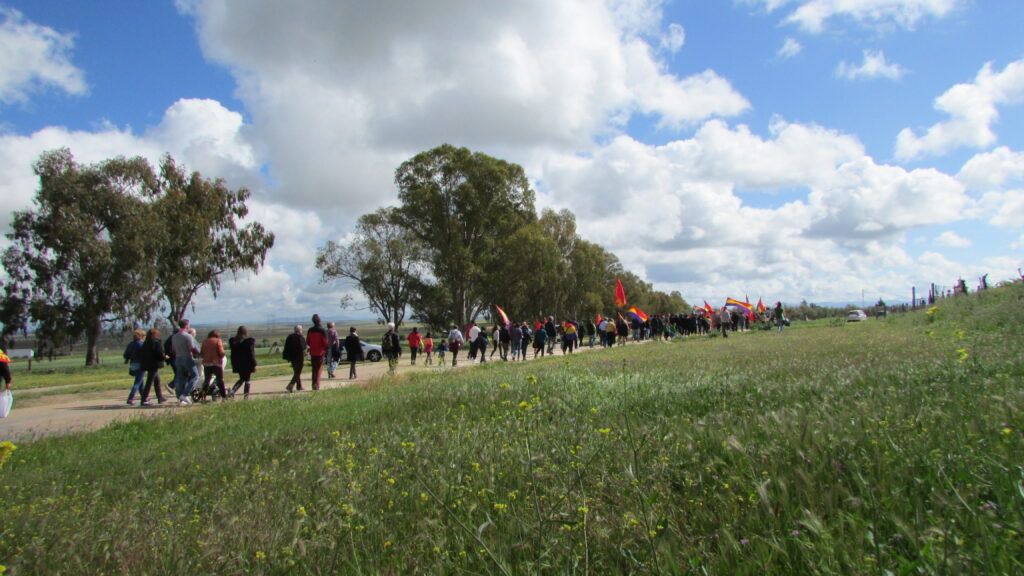
March to the Concentration Camp during a Tribute to the victims. Photograph: AMECADEC
The site’s enduring relevance as a place of memory lies in its embodiment of the four pillars of historical justice: truth, justice, reparation, and guarantees of non-repetition.
Bibliographical references
Guillermo LEÓN CÁCERES (2022), “La memoria de las víctimas del franquismo en Extremadura. Una introducción a sus orígenes, configuración y activismo”, in José Ignacio URQUIJO, José Antonio PÉREZ and Marcelo
SÁNCHEZ-ORO (Coords.), La sociedad extremeña desde la Sociología. Claves para entender una realidad social en transformación, Servicio de Publicaciones de la Universidad de Extremadura, Cáceres, pp. 107-136.
Guillermo LEÓN CÁCERES, Antonio D. LÓPEZ RODRÍGUEZ and José Ramón GONZÁLEZ CORTÉS (2011), “El campo de concentración de Castuera: del olvido forzado forzado a lugar de memoria y recurso didáctico”, Revista de Estudios Extremeños, volume LXVII, number II, pp. 527-594.
Antonio D. LÓPEZ RODRÍGUEZ (2006), Cruz, bandera y caudillo. El Campo de concentración de Castuera, CEDER La Serena, Badajoz.
Antonio D. LÓPEZ RODRÍGUEZ (2022), La guerra civil en el Partido Judicial de Castuera (1936-1939), Doctoral Thesis, University of Extremadura.