Emanuele Morezzi, Politecnico di Torino; Chiara Mariotti, Università Politecnica delle Marche; Leila Signorelli, Alma Mater Studiorum Università di Bologna; Alessia Zampini, Alma Mater Studiorum Università di Bologna
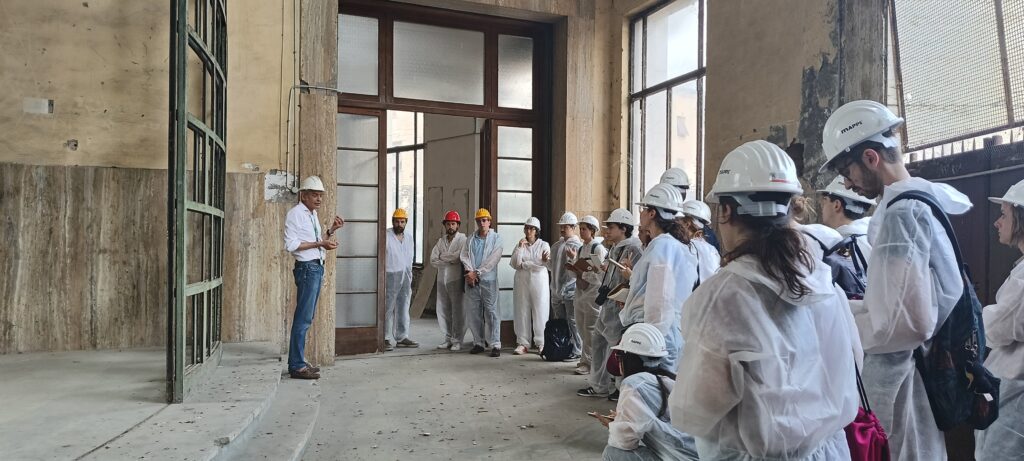
Cover image: Experimental lab at the former House of the Fascist Party (Predappio, Italy).
The project Dissonant Heritage and War. Conservation and Communication of a Difficult Legacy (Co.Co.War) is conceived as a critical reflection and systematic framework for addressing theoretical issues and exemplary cases concerning interventions on Dissonant Heritage. The research focuses on the social, political, ethnic, and cultural processes that emerge in situations where heritage is marked by a divisive charge generated by either military or interpretative conflict, or by manipulations of the message or cultural content associated with the asset.
Such dynamics lead communities to adopt attitudes of neglect or denigration, ultimately expressed through acts of abandonment, transfiguration, or destruction. It is funded by a national grant (Progetti di Ricerca di Rilevante Interesse Nazionale – PRIN, 2022) and began in October 2023. It will conclude in February 2026, with the opening of a travelling exhibition in Turin, at the Castello del Valentino, and a final conference.
The project is grounded in the analysis of a significant sample of heritage cases undergoing different processes – including re-signification, rejection, or damage – and provides a robust matrix – the backbone of the project, also integrated into an openaccess geoapp in which they are catalogued according to a shared glossary. The matrix enabled the research units to observe the phenomenon from a broad large transnational perspective, recognising patterns in the origins of dissonance, and enabling advancement in the understanding of this field. Within these processes, the communication of values and disvalues – beyond stigma – is part of a new way for the community to engage with this complex heritage.
The case studies are examined to identify strategies – direct and indirect – useful in opening a path towards the conservation of Dissonant Heritage: the project considered not only heritage traditionally associated with difficult or contested memory, but also cultural assets that are acquiring dissonance through a communication that manipulates stratified memory, with the aim of transforming them into a divisive element within the community. The project, now in its final phase, aims to explore innovative tools for identifying and managing this new way dissonance takes shape by mapping situations in which tensions emerge through manipulated communication, and analysing virtuous cases of re-signification of Dissonant Heritage. The goal is to outline targeted valueoriented strategies for the preservation and communication of these architectures.
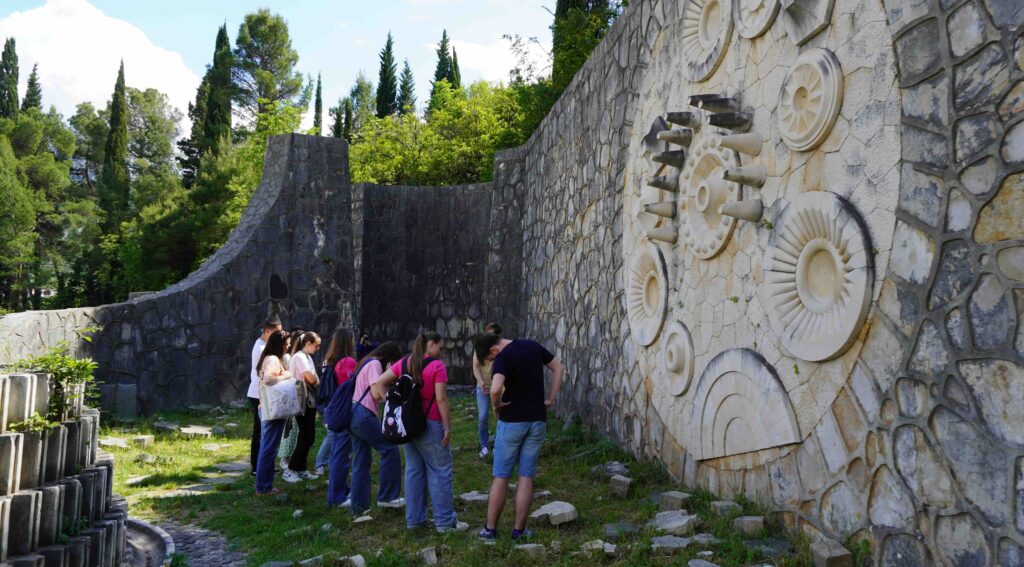
Experimental lab at the Partisan Memorial Cemetery (Mostar, Bosnia and Herzegovina).
Questioning the Role of Heritage Conservation
Wars and conflicts leave behind rubble to be removed, cities and societies to be rebuilt, and traumas to be overcome. Beyond these material and social wounds – often impossible to heal – conflicts also bequeath to the future another kind of difficult heritage: seats of power, military structures, headquarters of political institutions, and even monuments burdened with uncomfortable identity meanings. These structures, imbued with new semantics, often become symbols of new perceptions among local populations, leading to forms of cultural heritage repudiation and new attempts at post-conflict identity reconfiguration.
Historic architectural heritage, normally the object of protection and preservation, thus becomes an instrument not of social unification and democracy, but of division and amplified tension among still-divided factions. Within this framework, the discipline of architectural restoration has drawn upon the words of Roberto Pane in his essay Jung e i due poli della psiche (1987), which theorised the concept of psychological attitude, underlining how the perception of heritage in conflict by the population should be linked to Cesare Brandi’s reflections on historical and aesthetic standpoints. The innovative scope of these concepts is even more relevant today, in light of international phenomena such as cancel culture and protest movements against the monumentalisation of disowned heritage or heritage at the centre of interpretative conflicts.
At the European level, such themes have been central to Lowenthal’s research on Heritage Studies (1996), focusing on interpretative conflict arising from war or semantic misinterpretation of heritage, and to Assmann’s work (2015) on the management of traumatic memory. In Tunbridge and Ashworth’s typology of dissonance origins (1996), the Dissonant Heritage addressed by this project overlaps their second and third categories: heritage located at the centre of communities with separated memories and discordant meanings, and heritage where dissonance arises historically due to societal changes causing value and message inversions.
Sharon Macdonald, in Is ‘Difficult Heritage’ Still ‘Difficult’? (2015), questioned whether addressing difficult heritage can today be seen not only as possible, but also as producing positive effects, rather than as an act of damnatio memoriae. Yet it remains challenging to achieve shared interpretations of those heritages, whose dissonance, as in recent conflicts, stems from deliberate manipulation of historical stratifications and values to legitimise ethnic, political, or religious supremacy.
Cultural heritage thus becomes central to ‘identity politics’ (Graham & Howard 2008), and its narration plays a crucial role in hybrid warfare strategies, where the control of information (infowar) becomes a genuine weapon for military success – especially when disseminated via platforms that easily escape verification of objectivity and truth (Facebook, Tripadvisor, X, Telegram, Wikipedia). Unsurprisingly, the NATO report on Identity Wars (2017) emphasises the systemic nature
of these threats in contemporary conflicts. The effect is to embody, as in well-known cases such as regime-associated rationalist heritage, concentration camps, intentional monuments, tangible markers of a divisive past, which societies may seek to erase through renewed mechanisms of damnatio memoriae and iconoclasm.
The communication of the values of Dissonant Heritage is crucial to its preservation, as demonstrated by cases such as ATRIUM Association and Cultural Route – Architecture of Totalitarian Regimes of the 20th Century in European Urban Memories – (Battilani et al. 2024; Leech 2018), a renowned international network of sites that has provided a turning point in the recognition and management of the architectural legacy related to undemocratic regimes. Similarly, the role of architecture in processes of misinterpretation can contribute to the search for shared truths, as shown by the work of the research centre Forensic Architecture (University of London).
Conservation Strategies
The project outlines a method for theorising and operationalising the conservation of monuments that, in our contemporary context, have become divisive, where the “dark side of histories” highlights primarily disvalues within the system of meanings attributed to the heritage. Identifying conservation strategies for uncomfortable heritage (dissonant, difficult, contested, tabooed, etc.) is essential to ensure that in the future, under a different cultural climate – based on a renewed Kunstwollen (Riegl 1903) – such inheritance can still be narrated, analysed, and re-signified with updated tools.
The transmission of heritage to the future remains the primary objective of restoration, grounded in a method that, by revealing all material and memorial layers, enables cultural awareness and critical oversight throughout the intervention process. If the role of architectural conservation as a discipline has been to unveil meanings, stratifications, and highlight the power of interpretation for the purposes of valorisation, protection, and preservation, then the same critical and cultural engagement can only be beneficial in treating the relationship between heritage, identity, and the values of ‘new forms’ of Dissonant Heritage. In this perspective, the role of architectural conservation is not limited to the material conservation of heritage, but extends to cultural supervision aimed at enhancing and communicating its meaning to the community.
The management of such delicate communication policies represents an innovative challenge, not only for safeguarding structures and memory of the past, but also for redefining the significance of architectures at the centre of interpretative and semantic conflicts. Indeed, it is this interpretative conflict that poses a new risk to heritage preservation, requiring urgent attention from scientific research to define tactics that can counteract propagandistic communication and defuse emerging tensions surrounding the value of heritage.
The Co.Co.War project has so far explored the development and implementation of value-oriented strategies capable of reversing the processes that have attributed negative value to cultural heritage, compromising its conservation through distorted communication. The research aims to work precisely on the characteristics that manipulative communication has exploited by retracing a kind of reverse trajectory that ultimately transforms these sites into platforms for dialogue, promoting diversity and multiplying the benefits from heritage to territory in a systemic approach that involves culture, society, economy, and environment (Europa Nostra 2015). The idea is to transmit the history of these heritages in a way that considers their tangible (material) and intangible (meaning-based) stratifications, thereby highlighting their complexity (Architects’ Council of Europe et al. 2018).
Understanding as a key tool for future actions
To achieve effectiveness in the field of dissonant heritage, it is necessary to study the state of the art, investigate restoration theory and the related cultural debate, and involve experts and stakeholders in establishing dialogue with local communities, launching participatory projects to explore community perceptions of such heritage. Co.Co.War is rooted in an evidence-based method that seeks to bring closer together the two actions of “assessment” and “understanding”: starting from a deep knowledge of the state of the art, among the case studies analysed in the matrix, three were selected using a scaled approach that considered both the types of heritage assets under investigation and their location (national, European, and extra-European), taking into account different origins of dissonance.
The former House of the Fascist Party (Italy), the Partisan Cemetery in Mostar (Bosnia and Herzegovina) and the Armenian heritage across the borders were at the centre of the Experimental Labs conducted between May and July 2025, nurturing the research findings with feedback from real world contexts.
The Italian experimental lab, held at the former House of the Fascist Party in Predappio from 9 to 15 June 2025, was coordinated by the research unit of the Università Politecnica delle Marche, with support from the University of Bologna and Politecnico di Torino. The initiative aimed to critically engage with the Fascist legacy by operating within a site of profound symbolic significance – Predappio, the birthplace of Benito Mussolini – where Fascist propaganda once materialised the myth of the Dux through urban and architectural forms, and where latent tensions between cancel culture and polarised narratives persist.
The lab was an intensive inter-university workshop involving master’s students from the three universities, highlighting that dealing with dissonant heritage requires not only conservation, but also ethical and educational challenges. The event was held on the centenary of Predappio’s foundation (1925-2025), in collaboration with the Municipality of Predappio, the ATRIUM Cultural Route, and SERINAR – the company currently managing the Rocca delle Caminate, a medieval fortress transformed in the 1920s into Dux’s castle through a restoration that itself served as an instrument of propaganda.
Although the lab focused on the House of the Fascist Party, its scope extended to the town’s wider urban context, conceptualised as Mussolini’s ‘urban biography’. Designed by the architect Arnaldo Fuzzi, the House is a paradigmatic example of Fascist ideology and a manifesto of twentieth-century architecture in Italy [Fig. 1]. Its dissonance emerged after the Second World War with the fall of Fascism and the discrediting of its symbols: after its decommissioning, it
suffered decades of neglect, which exacerbated its fragile condition.
Since 2011, a process of heritage recognition and enhancement has been shaped by negotiations over the building’s difficult past and potential reuse. The workshop aimed to contribute to this process of re-signification, fostering
the transformation of the site from a neglected or divisive place into one of mediation and critical reflection. Adopting a design-thinking approach and guided by the teaching team, students investigated this pilot case through fieldwork, lectures, and focus groups, in dialogue with architects from Studio Valle in Rome, responsible for the structural project and a preliminary reuse proposal that includes a museum section. The key task was to focus on the museum concept and exhibition design through a sensitive inquiry into how architecture, as physical space, can evoke emotions, memories meanings, while emphasising the role of artistic reflection in the culture of remembrance. The results were presented in a public forum attended by local authorities, experts, and community members, fostering an open discussion on the building’s future within the broader European contemporary discourse on the legacy of totalitarian
regimes.
Between 12 and 14 June 2025, an experimental lab was conducted in Mostar by the research unit of the Politecnico di Torino, in close collaboration with the Nansen Dialogue Center (NDC). Conceived as an operative and reflective platform, the lab explored innovative methods for analysing and representing perceptions of dissonant heritage, focusing
on the Partisan Memorial Cemetery [Fig. 2]. Combining fieldwork, interviews, and visual experimentation, it sought to investigate how local stakeholders – experts, institutional representatives, and young citizens – perceive, interpret, and emotionally engage with this complex cultural site, and how these perceptions intertwine with the social and political
transformations that have marked Mostar since the end of the Second World War. The Partisan Memorial Cemetery – locally known as Partiza – is a paradigmatic example of dissonant heritage.
Commissioned by the Yugoslav government and designed by the architect Bogdan Bogdanović in the 1960s, it was conceived as a monumental tribute to the antifascist resistance and the ideals of brotherhood and unity among the
peoples of Yugoslavia. During the socialist period, it was one of the most significant civic and commemorative spaces of the city, embodying the state’s official narrative of collective heroism and national cohesion. The Bosnian War in the 1990s radically altered its meaning, and it became a symbol of division: the monument suffered damage and neglect, became the target of repeated vandalism, and progressively lost its civic function.
Today, it remains a powerful but ambivalent site, oscillating between abandonment and attempts at symbolic reappropriation. The Mostar lab focused on perception through a dual methodological approach, integrating verbal and visual testimonies. On one hand, the research team conducted semi-structured interviews with selected experts – professors, researchers, architects, and directors of government institutions – to capture professional and personal interpretations of the cemetery’s history, transformation, present condition, and future reactivations.
On the other hand, with the support of NDC, a diverse group of young adults from Mostar participated in field and desk activities, encouraging them to express their perceptions through creative and visual tools. This integration of different methodological perspectives allowed for a comprehensive understanding of perception as a cognitive, emotional, and
representational process. Expert accounts highlighted divergent narratives regarding the cemetery’s legitimacy and symbolism, while participatory outputs revealed intimate, sensorial engagement. The combined materials enabled the team to trace a complex cartography of perceptions – from estrangement to empathy, and from indifference to renewed curiosity – reflecting the multiplicity of ways the local community relates to this contested site. Thus, the lab encourages reflection on the epistemological role of perception in the conservation and communication of dissonant heritage, proposing a model of understanding that links memory, emotion, and representation in the collective construction of meaning around sites marked by conflict and ideological transformation.
The experimental lab led by the research unit of the University of Bologna in Armenia was part of the “Restoring the past – shaping the future” summer camp organised by the Center for the Study, Preservation and Enhancement of Armenian Cultural Heritage (SIREH) in collaboration with the National University of Architecture and Construction of Armenia (NUACA), Yerevan State University and the Academy of Fine Arts (TBC).
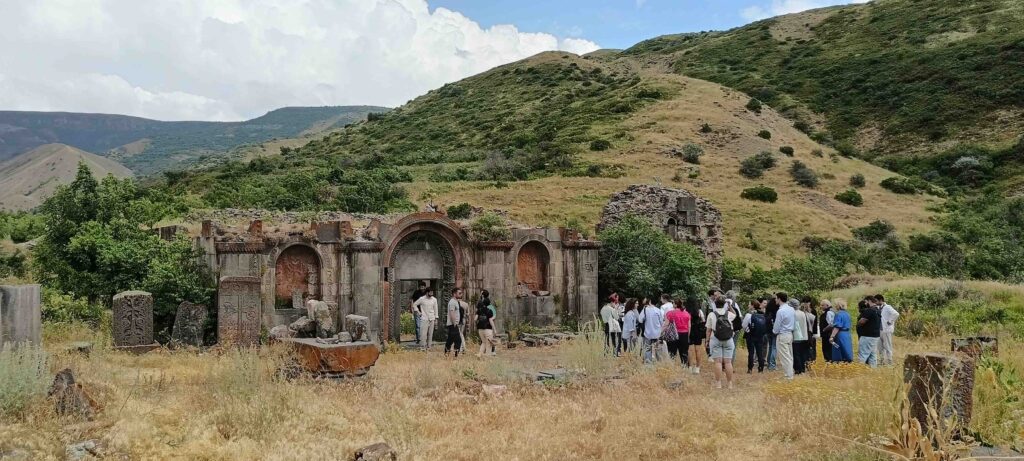
Experimental lab on forgotten Armenian architectures.
From 2 to 9 July 2025, a series of activities and experiences were carried out with students and experts from different fields to have a multi-perspective and multi-disciplinary view of the architectural and artistic heritage of the country [Fig. 3]. The aim was to understand heritagisation processes, especially in contested or forgotten areas. With a focus on
the existing interactions between monuments, the landscape, and local communities, the experimental lab explored strategies for transmitting cultural heritage to new generations.
To better frame and understand the importance of conserving artworks, it was necessary to have students work on recognising the values and disvalues of forgotten Armenian architecture, also including the intangible qualities that contribute to shaping the perception of the place. Analysis activities and work on the identity of places were crucial in
laying solid foundations for hypothetical enhancement projects that the students of Architecture, Fine Arts and Anthropology were called to carry out by working together. Moreover, to gain a deeper understanding of the real needs of the actors working in these contexts, the team attended the “Heritage Organizations Agora” organised by SIREH in July, conducting interviews with local associations, NGOs and institutions working in the fields of cultural heritage, discerning its role characterised by ongoing conflicts and tensions.
Drawing on hands-on experience in experimental labs and extensive mapping of dissonances in heritage across Europe and beyond, Co.Co.War seeks to rethink approaches to the past, and engage with the diversity of cultures, nations, communities, classes, genders, and generations, while addressing the challenges of digital transition and supporting heritage communities. In this context, it emphasises the crucial role of culture and heritage in overcoming symbolic violence and fostering understanding of the ‘Other’.
References
Assmann A. (2015). Ricordare. Forme e mutamenti della memoria culturale, Bologna, Il Mulino.
Battilani P., Belcastro M.G., Kowalski K., Nicolosi T. (2024). Dissonant Heritage. Concepts, Critiques, Cases, Bologna, University of Bologna.
Europa Nostra (2015). Cultural Heritage Counts for Europe, Full Report, Krakow, CHCfE.
Graham B., Howard P. (2008). The Ashgate Research Companion to Heritage and Identity, Aldershot, Burlington, Ashgate.
Leech J.P. (2018). The anxieties of dissonant heritage: ATRIUM and the architectural legacy of regimes in local and European perspective, in H. Hökerberg (Ed.), Architecture as propaganda in twentieth-century totalitarian regimes, Firenze, Edizioni Polistampa, pp. 245-260.
Architects’ Council of Europe, EFFORT, ERIH, Europa Nostra and FRH, Leeuwarden Declaration. Adaptive re-use of the built heritage: preserving and enhancing the values of our built heritage for future generations, Leeuwarden, the Netherlands.
Lowenthal D. (1996). Possessed by the past. The heritage crusade and the spoils of history, New York, Free Press.
Macdonald, S. (2015). Is ‘Difficult Heritage’ Still ‘Difficult’? Why Public Acknowledgment of Past Perpetration May No Longer Be So Unsettling to Collective Identities, in “Museum International”, vol. 67, Issue 1-4
Museums Managing the Tensions of Change, pp. 6-22.
NATO (2017). NATO and Cultural Property. Embracing new challenges in the Era of Identity Wars, Copenhagen, CHAC
Pane R. (1987). Carl Gustav Jung e i due poli della psiche, in “Attualità e dialettica del restauro”, Chieti, Solfanelli, pp. 299-306.
Riegl A. (1903). Der moderne Denkmalkultus. Sein Wesen und seine Entstehung, Wien-Leipzig, W. Braumüller.
Tunbridge J., Ashworth G.J. (1996). Dissonant Heritage: The Management of the Past as a Resource in Conflict, Chichester, John Wiley & Sons.
Co.Co.War Official Web Site: https://cocowar.com/