Akiko Tsuchiya and Aurélie Vialette (eds.) Albany: State University of New York Press, 2025. 320 pp.
ISBN 9798855800845 (hardback)
A review by Jo Labanyi, New York University
As the editors of this volume note, Spain has been slow to recognize the human rights abuses, including slavery, resulting from its former empire, in part because of the urgent need to memorialize the victims of the Francoist repression in and after the Spanish Civil War. As Tsuchiya and Vialette remark in their introduction, Spain’s Democratic Memory Law makes no mention of empire. This book—unlike previous studies of slavery in colonial Spanish America—focuses on its legacies (in the plural) in Spain from the nineteenth century to the present. The mix of scholarly essays and interviews aims to reach beyond academic circles.
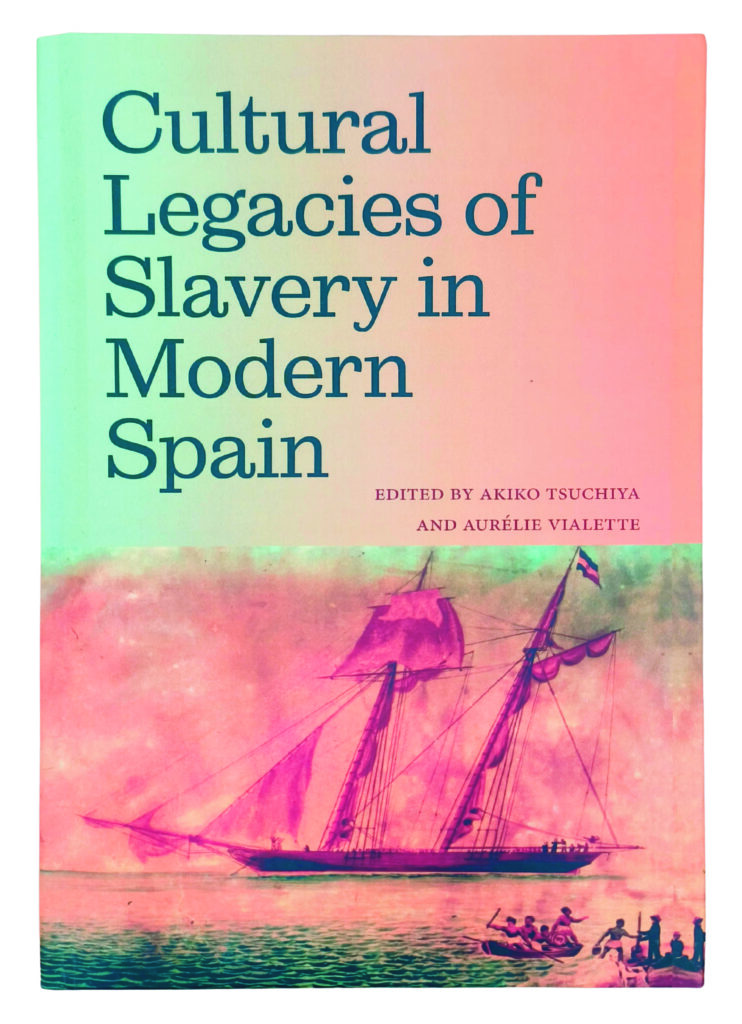
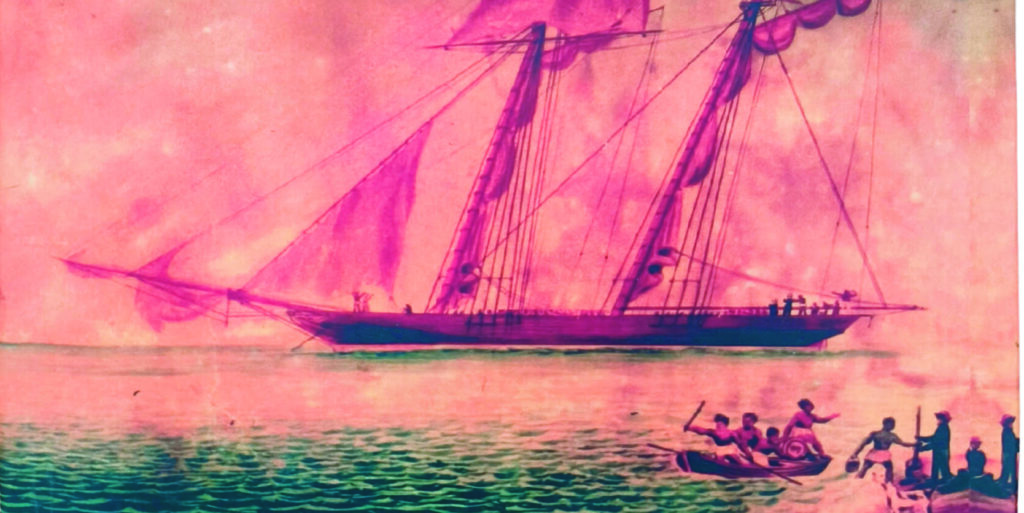
The editors’ introduction notes that the height of Spain’s involvement in the Atlantic slave trade (principally to Cuba) was the mid-nineteenth century, when slave trading (but not slavery) had been declared illegal. As Vialette comments in her own essay, the banning of the slave trade raised the price of slaves, making slave trading more profitable. Those profits, the introduction notes, underpinned industrialization in Catalonia.
While Catalonia features prominently in the book, the geographical coverage is broad. Part 1, based on archival sources, discusses Spanish colonial West Africa and the Philippines, the links with slavery of Spanish families based in Britain, and Catalonia. Part 2 explores today’s memorialization of slavery in Catalonia, Madrid, Cádiz, and the Canaries. Part 3 examines the legacies of Spain’s involvement in slavery in literature, visual culture, and music, including interviews with Afro-descendant cultural workers.
Benita Sampedro’s first chapter, “The Houseboys of Fernando Poo,” reads two African personal narratives—the semi-fictional Una lanza por el Boabí (1962) by Daniel Jones Mathama, son of the wealthy African plantation-owner on whom the protagonist is based, and the 1961-2 notebook and diaries of Nigerian Linus N. Gheme, houseboy to a Portuguese settler family in Fernando Poo—to show how houseboys resisted, and in the second case legally challenged, their exploitation. The semi-servitude of houseboys in elite African as well as white settler households shows the complexity
of colonial structures.
Kirsty Hooper’s second chapter examines the links to slavery of three Spanish families (from Cádiz, Havanna, and Puerto Rico) living in London during the nineteenth century, after Britain’s abolition of the slave trade in 1807. Her research shows the ploys adopted by these slave-trading or slave-owning families to mask the source of their wealth. The chapter’s fascinating historical detail reminds us of the repression of slaves in Cuba and Puerto Rico in the 1840s by Spanish liberal politicians General O’Donnell and General Prim, respectively. Aurélie Vialette’s third chapter explores the role of the major Spanish slave trader Antonio López y López (knighted as Marquis of Comillas by Alfonso XII) as founder of the Philippine General Tobacco Company. Her focus is on how the company’s archive whitewashes its links to the slave trade, in keeping with a sanitized official discourse that allowed the capture and enslavement of Muslims in the Philippines. Like Hooper in Chapter 2, Vialette reveals the intricate networks of kinship that consolidated slavery as a
global business enterprise.
In Part 1’s final chapter, Martín Rodrigo-Alharilla and Juliana Nalerio argue that the decisive factor in the shift from Spain’s early modern blood purity statutes, which targeted religious others (Jews and Muslims), to modern racism, based on skin color, was the Atlantic slave trade’s equation of slaves with Blacks. They note that, in slave-owning eighteenth century colonial Spanish America, blood purity laws started to be used to bolster white privileges. Examining the links between nineteenth-century Catalonia and Cuba, they show how the equation of the terms “negro” and “slave” persisted even when referring to free people of African origin in Barcelona.
Part 2 opens with Akiko Tsuchiya’s chapter on the monuments in Barcelona to the previously mentioned slave trader Antonio López y López and to Columbus. She notes the Franco dictatorship’s restoration of the monument to López in 1944, after its demolition by anarchists at the start of the Spanish Civil War, and that its removal in 2018 left standing its pedestal, which celebrates López’s transnational business enterprises. She shows how the erection of the monument to Columbus in 1888, for the Barcelona Universal Exposition, coopted him to celebrate Catalonia’s medieval empire, contributing to the reluctance, still today, towards removing it. Particularly interesting is Tsuchiya’s account of art activists’ interventions which have given both monuments new meanings.
Ulrike Schmieder’s Chapter 6 is a mine of information about the extensive links to slavery of Cádiz and Madrid, none of them commemorated in either city. Cádiz’s museums and tourist spots celebrate the city’s past as the hub of Atlantic trade and it still has a monument to Antonio López’s son Claudio, who continued his father’s business ventures (the Catholic Church considered canonizing him). The monument to the 1812 Constitution of Cádiz says nothing about its exclusion of Afrodescendants from citizenship; local abolitionists are not honored. The account of Madrid details the many statues and street names honoring enslavers, and stresses the Spanish royal family’s involvement in slavery, notably Carlos III (who owned 20,000 slaves) and Queen Regent María Cristina (whose husband was involved in the slave trade).
Chapter 7, by Jeffrey K. Coleman, is a fascinating critique of the Museo Atlántico off the coast of Lanzarote, whose underwater sculpture garden, comprising over 300 human statues, calls attention to Africans drowned in the middle passage as well as in trying to reach Spain in recent decades. While conceptually interesting, the installation repeats the invisibility of those it honors (the statues can be seen only by those with scuba-diving training) and condemns them to a second death.
Part 2 ends with the editors’ interview with the coordinator of the European Observatory on Memories (EUROM), Oriol López Badell, and historian Celeste Muñoz Martínez, who heads EUROM’s colonial memories section and the Spanisg branch of the Trans-Atlantic Redress Network. They outline the successive stages of EUROM’s investigations into colonial memory, noting that the impulse has come from Afro-descendants and activists, with institutional recognition lagging behind. Despite the Catalan Generalitat’s 2021 apology for the crimes of colonialism, they feel that Spaniards still largely view empire as a positive feature of Spain’s past.
Part 3 starts with Gustau Nerín’s analysis of literary and cinematic representations of early nineteenth-century slave trafficker Pedro Blanco, owner of a vast slave factory in today’s Sierra Leone. Nerín shows how the many novels about him from 1860 on depicted him as a heroic adventurer, until David Pesci’s 1987 English-language novel Amistad, followed by Steven Spielberg’s 1997 film version, spawned a succession of literary representations in English, Spanish, and Catalan that damned Spain’s involvement in global slavery networks.
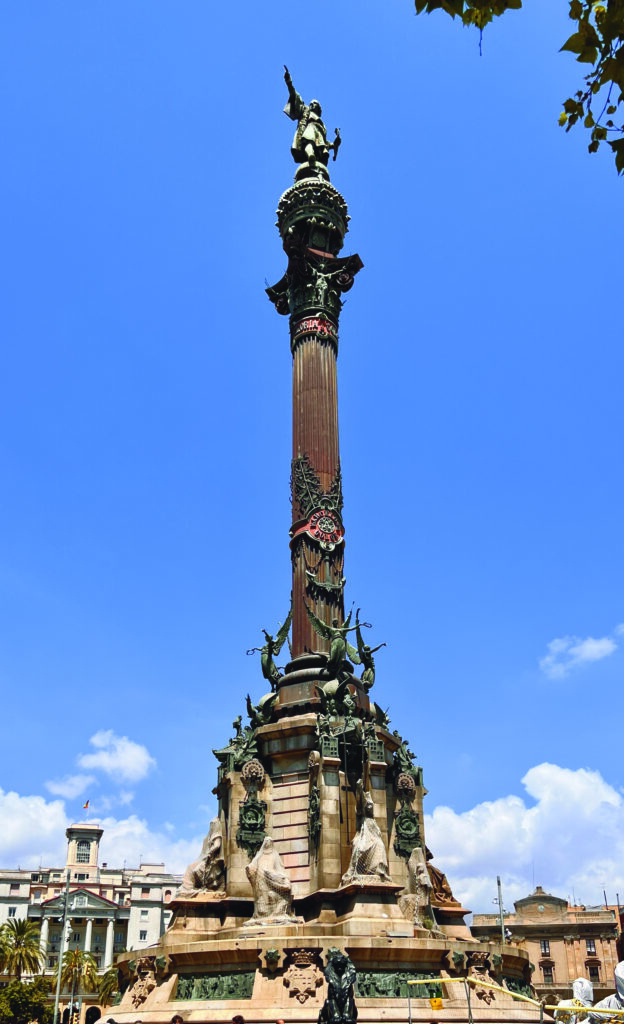
Columbus monument, Barcelona, July 2023. Source: RayAdvait, CC BY-SA 4.0, via Wikimedia Commons
In Chapter 10, Rosalía Cornejo-Parriego explores artistic and literary representations of the Black child Luz adopted by the 13th Duchess of Alba, the possible model for Goya’s La maja desnuda. She sets Goya’s painting and drawing of Luz in the context of a European vogue for portraits of Black children as luxury possessions, and notes the stress on the Duchess’s magnanimity in Enlightenment poet Quintana’s poem to the child. Carmen Posadas’ 2016 novel La hija de Cayetana is seen as parodying the white savior narrative but ultimately buying into the myth of a benevolent Spanish colonialism.
Chapters 11 and 12 comprise interviews with Afro-descendant cultural workers. In the first, Tania Safura Adam, director of Radio Africa and curator of many exhibitions on the African diaspora, rejects the term “activist” and expresses skepticism about use of the term “decolonial”. Her focus is on showcasing the musical scene across the African continent, creating awareness of African cultural creativity rather than on redressing victimization. In the second, Black British flamenco practitioner Yinka Esi Graves, of Ghanaian and Jamaican descent and since 2013 resident in Seville, describes how flamenco has helped her articulate the erasure of Black women.
The final chapter continues this stress on Black creativity with the exploration of Africans’ contribution to flamenco by Miguel Ángel Rosales, director of the 2016 documentary Gurumbé. Canciones de tu memoria negra. Rosales rejects prevailing assumptions that flamenco’s African elements derive from the late nineteenth-century Hispanotropicalist assimilation of Caribbean rhythms, arguing that such assumptions erase the centuries old Afro-descendant presence in Spain thanks to slavery. He traces the history of Black Andalusian performers in the sixteenth to eighteenth centuries,
suggesting similarities with (but not origins in) musical expressions of the Afro-American diaspora.
The book offers a wealth of information about Spain’s involvement in slavery as well as about present-day Spanish attitudes towards it. Its structure—leading from stories of abuse to accounts of Black creativity—has been well thought out. The overall message is that much work remains to be done in Spain to produce public awareness of the country’s slaveowning and slave-trading past. It is good to know that the volume will appear in Spanish translation.