Krystel Gualdé, Nantes History Museum
All images: Memorial to the abolition of slavery, Nantes (Loire-Atlantique) © PHILIPPE PIRON /LVAN
In Nantes, there is a place where silence speaks, where footsteps slow, caught by the weight of a long-buried history. A vibrant place, on the riverbank, where memory takes form: the Memorial to the Abolition of Slavery. Its very existence, at the heart of this port city, stands as a powerful and dizzying dissonance. For between the seventeenth and nineteenth centuries, Nantes was France’s principal centre of the Atlantic slave trade — a commercial crossroads from which more than 1,800 expeditions set sail, tearing hundreds of thousands of men, women, and children from their homelands to deliver them to Europe’s colonial plantations in the Americas.
More than 555,000 people were deported under the flag of Nantes — in the name of a prosperity built on inhumanity. Although other cities, such as Bordeaux, La Rochelle and Le Havre, also participated in this trade in human lives, Nantes dominated. Its fortune was rooted in this globalised economy of violence: in the slave trade, the refining of sugar, the weaving of cotton, commercial alliances with Asia, and the beginnings of an incipient industrialisation. A network of powerful interests bound Europe, Africa and America together in a relentless and particularly brutal web.
The paradox is even starker when one considers Nantes was far from an abolitionist stronghold; it was, in fact, an avowed opponent. In 1794, the city fiercely resisted the first abolition of slavery proclaimed by the French Revolution. It celebrated Napoleon Bonaparte’s reinstatement of slavery in 1802 and continued illegal trading until 1831. For a long time, memory chose oblivion.
Today, that buried history has resurfaced. The Memorial to the Abolition of Slavery, inaugurated on 25 March 2012 — a highly symbolic date marking Britain’s abolition of the slave trade in 1807 — embodies the return of a past long accepted, yet repressed after the Second World War and during the era of decolonisation.
A joint creation by artist Krzysztof Wodiczko and architect Julian Bonder, the monument is the result of a long process shaped by debate, silent resistance and legitimate questioning.
From its inception, the project divided opinion. It was supported by associations representing people from France’s overseas territories, and politically backed by Jean-Marc Ayrault, then the city’s mayor, yet it also aroused unease and tension. Some considered its cost excessive; others felt the recently renovated Nantes History Museum was sufficient. More profoundly, the very idea of a memorial — unique in Europe — devoted entirely to this dark chapter of colonial history was unsettling. For remembrance demands confrontation with what we would rather silence, and in this case, it means bearing the weight of a profoundly shameful past.
Yet despite all this, the monument came into being — as a necessity, a response to accumulated silences, an obligation.
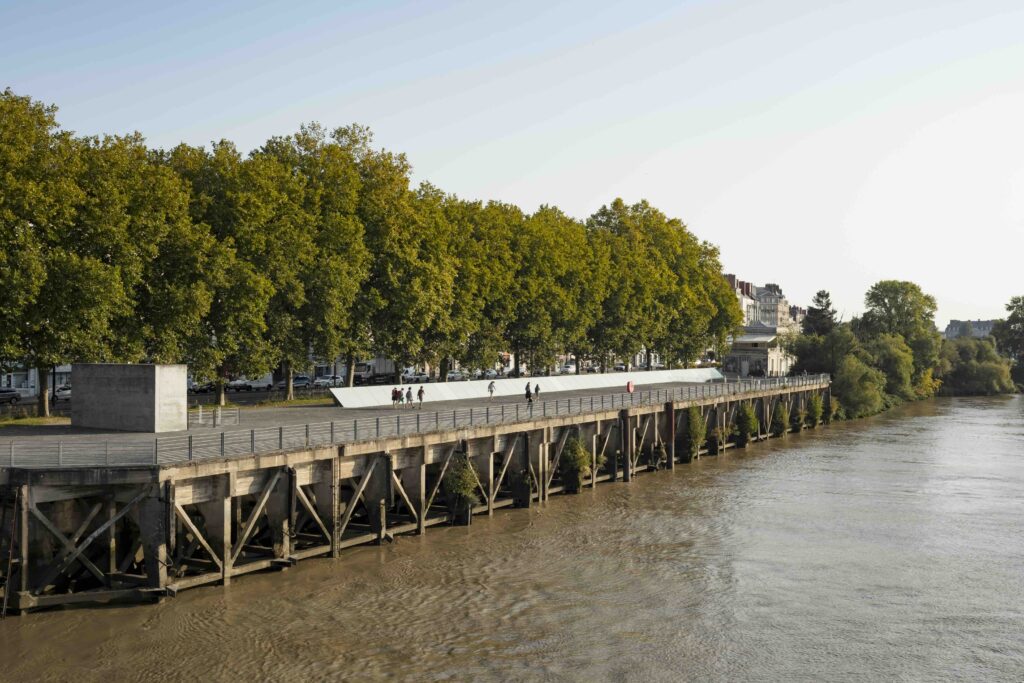
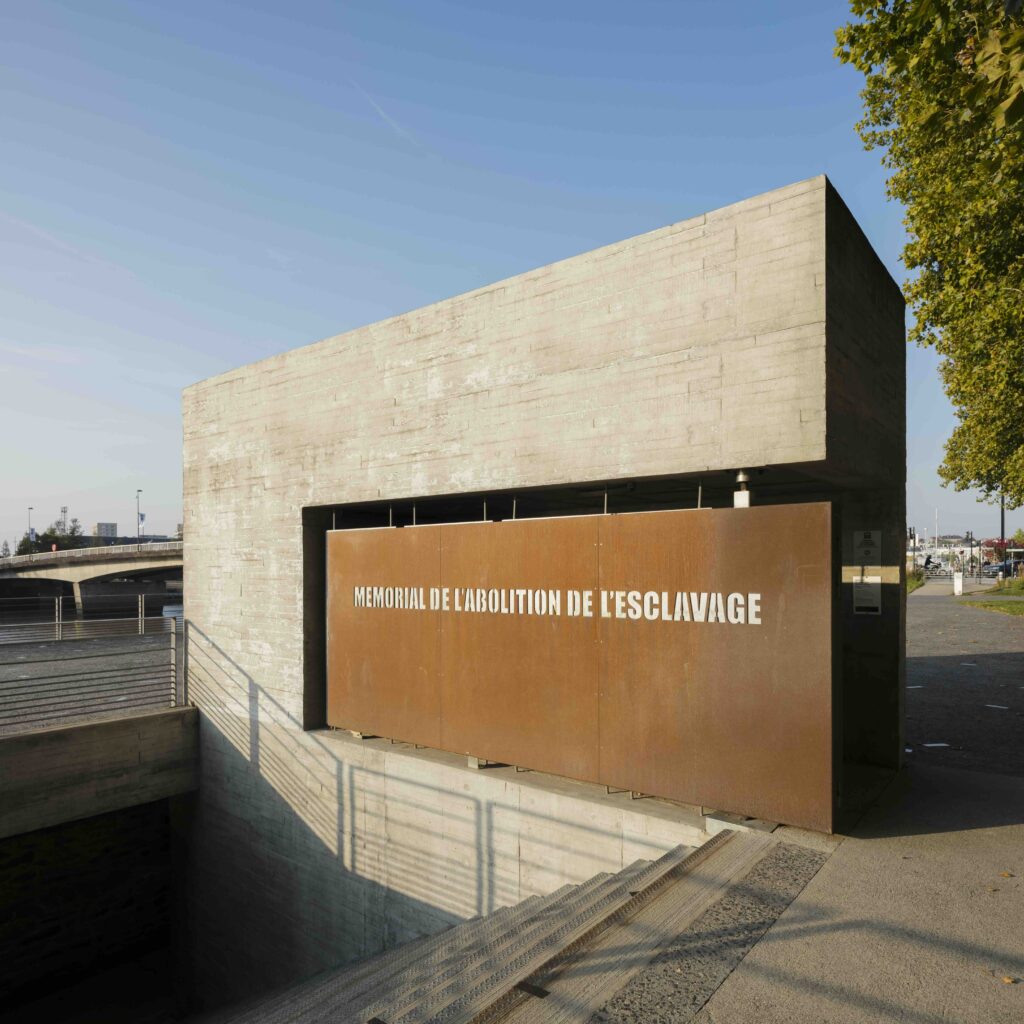
Built on the banks of the Loire, the Memorial unfolds as a space for reflection — a place of passage and awareness. It begins with a broad promenade bordered by glass plaques set into the ground. Each bears the name of a ship, a date, an African port of departure, and a number of captives. Together, they form a murmured litany that accompanies the rhythm of one’s steps, an invisible map etched into the riverside. Some names stand out: La Diane, Les Trois Frères, Le Père de Famille… and later, after 1789, La Liberté, L’Égalité, Le Ça ira — so many paradoxes that leave no one indifferent. In the very banality of these names, nothing betrays the unspeakable horror of the voyages they mark. It is here that confusion begins.
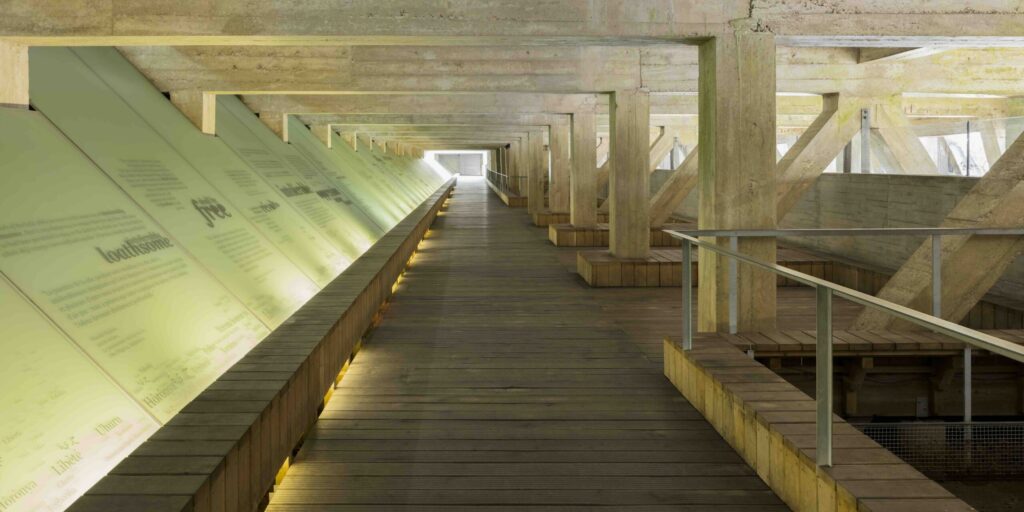
Then comes the descent. The visitor moves beneath the quay, into a concrete chamber both austere and luminous in its simplicity, yet dark, almost sepulchral, in its intent. The murmur of the river can be heard and light filters through like that in the hold of a slave ship. A faint soundtrack whispers. The space closes in; time seems suspended. To one side, an opening faces the Loire; to the other, a glass wall engraved with the word Freedom in forty-seven languages. A polyphonic chorus of voices rises, solemn and resonant, along this wall. They speak the unspeakable — of struggle, of hope, of revolt. From the words of enslaved insurgents to the speeches of abolitionists; from Enlightenment philosophers to twentieth-century poets; from the calls of past resisters to the appeals of today’s activists.
Olaudah Equiano, once enslaved and later a writer, bears witness: “Today I am a free man, and I will never forget that my freedom was won at the price of unspeakable suffering.” Nearby, the voice of Toussaint Louverture, captured and imprisoned, still prophesies: “In overthrowing me, you have only cut down the trunk of the tree of Black liberty in Saint-
Domingue. It will grow again from the roots, for they are deep and numerous.” Then come the words of Victor Schoelcher — “Slavery is a violent and permanent negation of humanity” — followed by those of Martin Luther King, Aimé Césaire, Édouard Glissant, and Nelson Mandela. Each, in their own way, anchors memory in the present and reminds us that dignity is never a given right but a perpetual act of struggle.
This procession of voices functions as both a ritual and a call. It is not only about remembrance but about recognising that memory itself is action.
For the Memorial does not close upon the past; it opens onto the urgencies of the present. Far from being a mausoleum, it confronts us with the intolerable persistence of slavery in new forms. At the dawn of the twenty-first century, more than fifty million people worldwide still live under the yoke of forced labour, sexual exploitation, forced marriage or human trafficking. Women, children, and the most vulnerable continue to bear the cost of an unequal world.
What the Memorial tells us — silently yet with profound force — is that the memory of the slave trade is not a page turned, but a light cast upon contemporary realities we would rather ignore. It is not about guilt but about responsibility: to act, to prevent repetition, and to name the new chains, even if they are no longer made of iron.
Because it links past and present, the personal and the universal, the Memorial to the Abolition of Slavery is not merely a place of remembrance. It is a mirror held up to our age, a threshold towards ethical engagement. It reminds us that forgetting is complicity — and that only an active, living, and shared memory can prevent the return of the worst. Freedom, that fragile conquest, must always be defended, reclaimed, and passed on.