Carmina Gustrán Loscos, Commissioner for the Commemoration of “Spain in Freedom: 50 years”
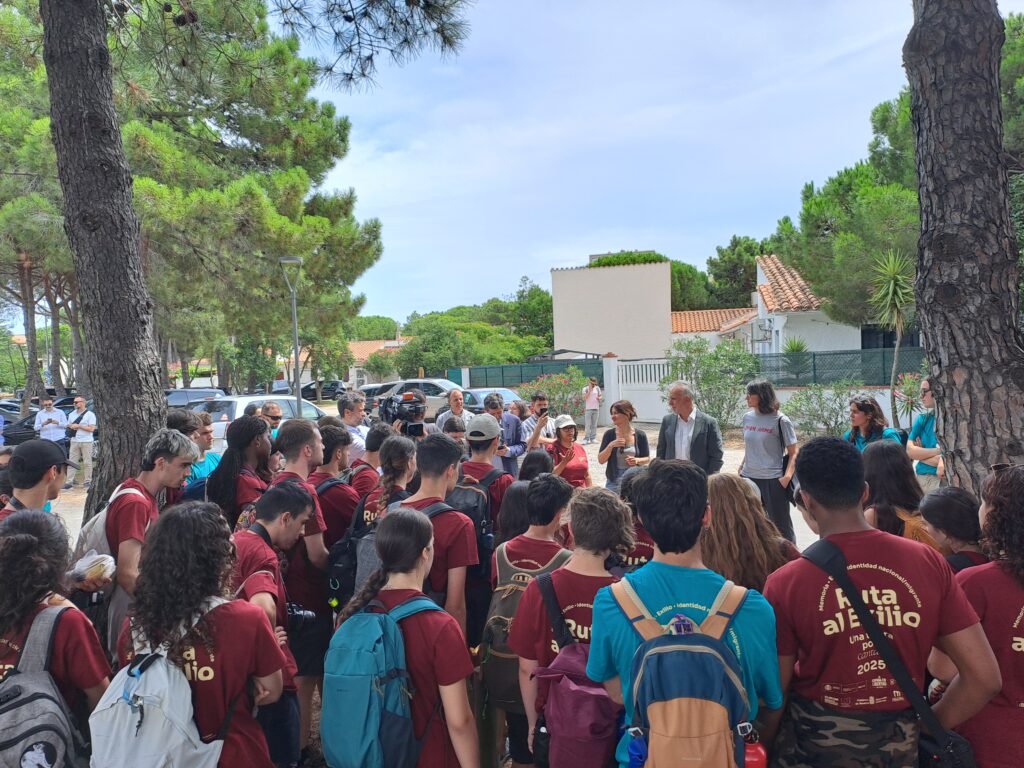
Cover image: Participants of the 5th Edition of Route to Exile were joined by Carmina Gustrán Loscos, Commissioner of Spain in Freedom. 50 Years; Ángel Víctor Torres Pérez, Minister of Territorial Policy and Democratic Memory; and Sira Abed Rego, Minister of Youth and Childhood during their visit to Argelès-Sur-Mer. July, 2025
20 November 2025 marks the fiftieth anniversary of Francisco Franco’s death. At the Commission of “Spain in Freedom: 50 years”, we focus on the possibilities that his passing created, on the long and difficult journey towards regaining freedom and democracy. In 2025, we remember the beginning of that collective achievement; we celebrate the prosperous, diverse and democratic nation that we have become. Also, we would like to invite all citizens to join us in reflecting on the future, on what kind of country and what kind of democracy we aspire to build together.
Commemorating 1975 is not about looking at the dictator, but rather looking at ordinary citizens, at the women and men who held strikes when they were forbidden, who turned parishes and neighbourhood associations into spaces of liberty, who opened classrooms and workshops in a country that wanted to live in freedom. It is to remember the thousands who died during and after the end of the dictatorship, victims of political violence — in prisons and summary executions, in demonstrations and violent attacks, in police custody and victims of terrorism. Fifty years later, the best tribute to that civic energy is not a complacent elegy, but an invitation to celebrate by thinking and to think by celebrating.
We commemorate the year 1975 because that is when a window opens — a window of risks and opportunities, of fears and courage, which cannot be understood without the struggles that came before or the transformations that followed. If we focused on the first democratic elections after Franco’s death in June 1977, or on the promulgation of the Spanish
Constitution in December 1978—if we looked only at major laws and great men—citizens would be reduced to background figures. And democracy, which is a collective task, would become the story of a few heroes. That is neither the memory we want nor the memory we need.
The commemoration we propose is both critical and grateful. Critical, because it acknowledges silences and debts: victims without mourning, repressions rarely discussed, inequalities that persist. Grateful, because it recognizes that, with all its limits, democracy expanded rights and horizons. It is not about choosing one or the other but about holding both at once. Democratic maturity means precisely this: celebrating without denying and revisiting without demolishing. We understand democracy as an open, ongoing process, one that calls for knowledge and for spaces where dialogue and reflection can flourish.
For all these reasons, our goals are threefold. Firstly, to understand and bring to light Spain’s recent past, particularly the years of dictatorship and the transition to democracy. Secondly, to celebrate the progress that our country has made over the last five decades and to honour the countless anonymous citizens who made it possible. And thirdly, to foster dialogue and create spaces for reflection and discussion—spaces to learn and to debate, to nurture critical thinking at a time when simplistic slogans, provocative ideas, and even hatred too often dominate.
Achieving this objective requires the advancement of Public History, that is, the practice of applying historical research, methods, and interpretation beyond the academic setting, engaging diverse publics in the understanding, preservation, and use of the past. We must bring the university into the streets and the streets into the classroom: open archives, organize walks through sites of memory, debate with documents and with art, listen to testimonies without turning pain into spectacle. Public History is not an academic trend; it is a democratic necessity. And it is along these lines that we have been working over the past few months. We have four strategic areas of work:
1) Official ceremonies and commemorations to remember, to repair — as far as possible — and to celebrate. To remember the deprivation of rights under Francoism and the struggle of so many anonymous individuals for freedom and democracy; to repair the harm done to the victims of the Franco dictatorship; and to celebrate how far we have come as a country over the past five decades. Commemorations, tributes, acts of remembrance and reparation, the initiation of proceedings to declare Sites of Democratic Memory, celebrations… Spaces, ultimately, for remembrance and education, for dignity and encounter.
2) Youth and democracy, to open spaces for dialogue with new generations — with those born in democracy, with the youngest among us. To speak about the past, the present, and the future, and above all, to use this commemoration as an opportunity to strengthen and reaffirm democratic values, respect for others, and peaceful coexistence.
3) Unsettling pasts, possible futures; to share with the wider public many of the findings from scholars and experts on Spain’s recent past, particularly concerning the Franco dictatorship and the Transition. We aim to learn from international experiences, to reinterpret spaces associated with the dictatorship through collective reflection, to analyze the past as a site of trauma, and to reflect on the role of art as a tool of resistance and transformation.
And 4) Popular memory/memories, to make popular memory visible beyond official narratives, and to recognize both collective and individual memory as part of a plural perspective on memory. Within the framework of Public History’s standards of rigour, we seek to highlight collective memory as a tool to open a dialogue with the events that led to democracy between 1975 and 2025, to analyze the current context and to imagine the new problems and dilemmas that will shape democracy in the next fifty years.
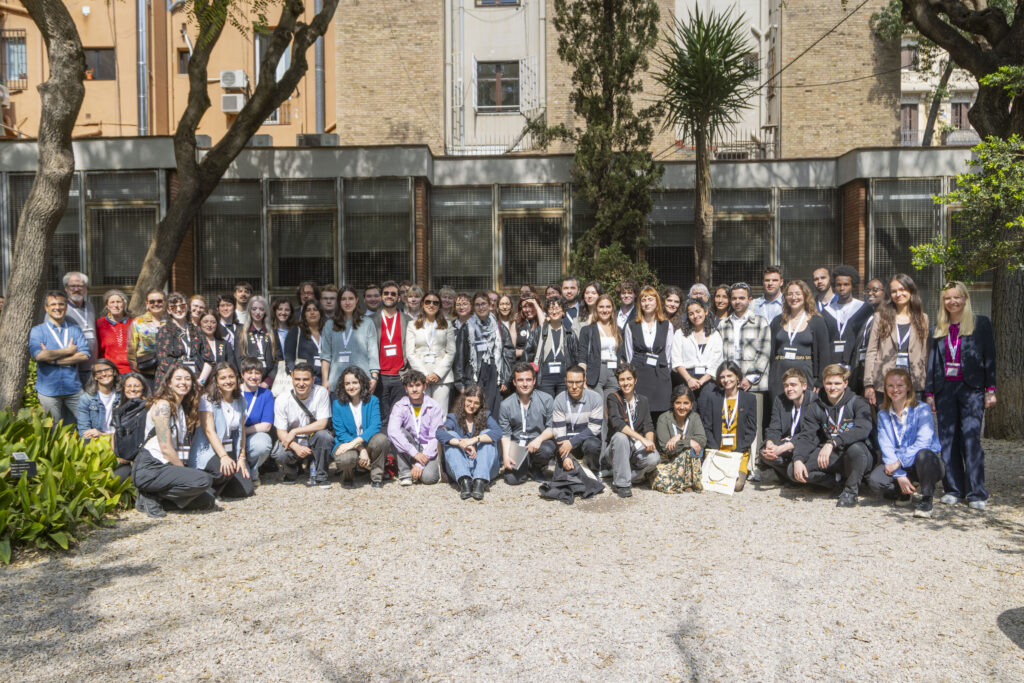
Group photo from the Youth and Memory Engagement meeting at the University of Barcelona, organized in collaboraiton with the EUROM
We have programmed the film season Images for a Country in Freedom at the Filmoteca Española, launched the roundtable series The Conquest of Freedom of Expression (Club Siglo XXI), inaugurated exhibitions such as Of choruses, dances and oblivion (National Anthropology Museum), Eroding Franco and Inquietud. Libertad y Democracia, and advanced in the recognition of Places of Democratic Memory — from Madrid’s El abrazo monument and Vitoria’s San Francisco de Asís church to sites of exile like Argelès-sur-Mer and the tombs of Antonio Machado and Manuel Azaña in France. We have taken part in international commemorations at Auschwitz and Mauthausen, supported the youth summer camp Route to Exile with youth institutions, and curated homages, concerts, and debates from León and Seville to Salamanca, Córdoba, and Barcelona. The events that followed — from the Festival du Cinéma Espagnol in Nantes to the SSIFF program, from Europalia season in Brussels to civic routes and neighbourhood archives — gave this commemoration reach and European context.
Memory demands proximity. It does not reside only in capitals or major museums; it lives in towns and neighbourhoods, in old factories and railway lines, in humble plaques and unmarked graves, in stories of exile and return. If commemoration is not local and decentralized, it reproduces the very inequalities it claims to challenge. That is why we value local networks — libraries, civic centres, memory associations, schools. There lies the real citizenry we want to reach out to.
And it demands comparison. Portugal, Greece, and Spain share rhythms, repertoires, and dilemmas. When we look at ourselves in that Iberian and Mediterranean mirror, domestic noise lowers and the quality of argument rises. Memory, when opened to the European context, becomes de-provincialized and more useful: we learn with and from others, we recognize affinities and differences and we find new answers for old questions.
Let us not idealize things: polarization exists. Memory touches nerves, which should not be sedated. But we must propose informed disagreement: plurality of voices, attention to evidence, care for those who suffered, and clear rules of engagement. Democracy is not unanimity; it is the art of turning enemies into adversaries. That must be learned and practiced. A well-curated exhibition, an urban route, a contextualized screening can do more for public conversation than a hundred social media trenches.
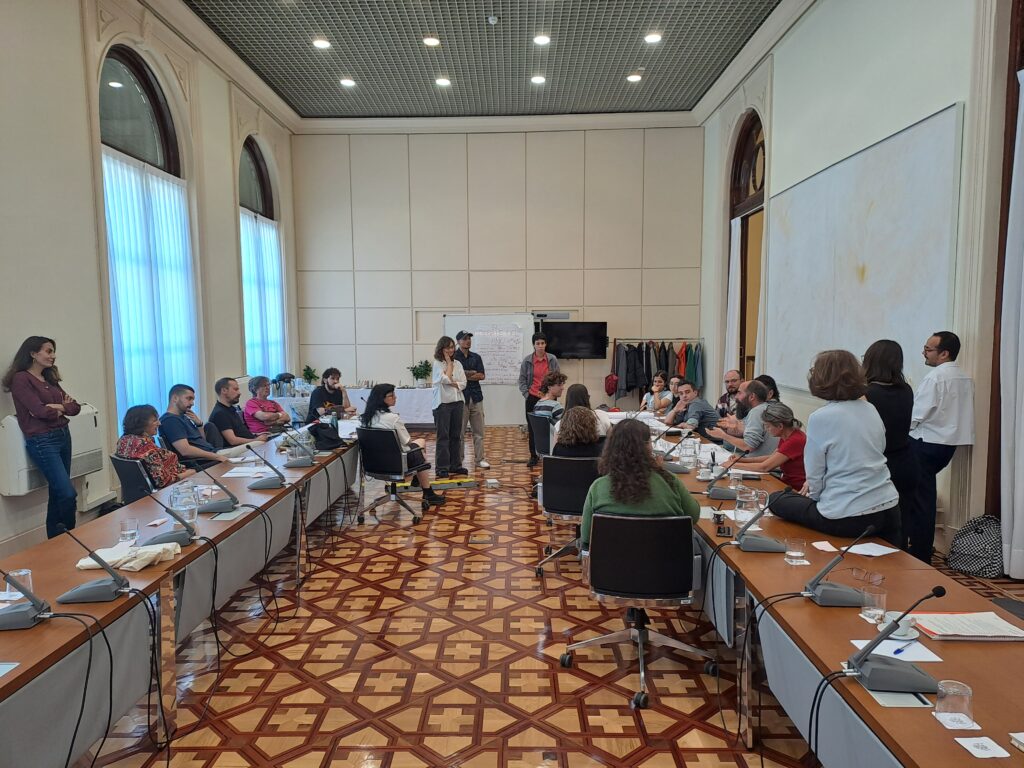
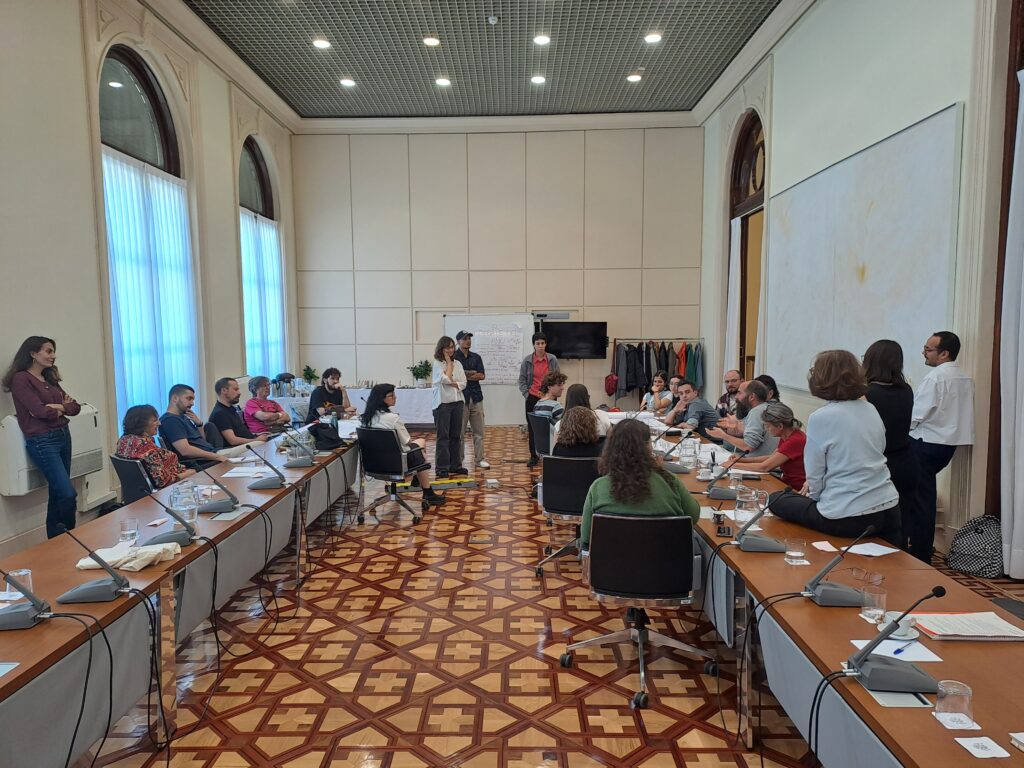
Working Group on Education and Democracy. Madrid, 2025.
Technology is part of the challenge. Synthetic recreations and disinformation trivialize, distort, and divide. The answer cannot be fear or blind rejection; it must be curation. We seek to label what is recreated, explain contexts, provide students with tools to identify fake news, release reliable materials for teachers and communicators. The goal is not to replace experience with a screen, but to widen access responsibly.
Finally, there is one symbol that speaks to us all: Cuelgamuros. Its re-signification cannot be solved with quick gestures. It requires history, ethics, and listening. We do not want to replace one symbol with another; we want to turn a difficult place into a civic classroom. That means public deliberation, participation of victims and experts, and pedagogical mediation that dignifies the visit. Doing it right will take time. Doing it wrong will cost us dearly.
Today, fifty years after Franco was buried in Cuelgamuros, this anniversary aims at two simple but demanding things. First, we have to make space for everyone, even for those who think differently, because democracy is precisely that: the art of living in difference. Secondly, we have to leave a useful trace —ensuring that every act, every event, every debate
leaves reusable materials, open archives, and tools for schools and communities. This commemoration should not be a peak of programming, but a capacity built for the future.
In short, commemorating 1975 is remembering that freedom was not a given. It was built from below and sustained from above; debated in institutions and fought for in the streets; it was sung, written, filmed, suffered and celebrated. Let us
honour that complexity. Let us do it with rigour and joy, with memory and vision. Because democracy is not a trophy in a display case but rather it is a daily practice that must be learned, taught, cared for and, above all, exercised.